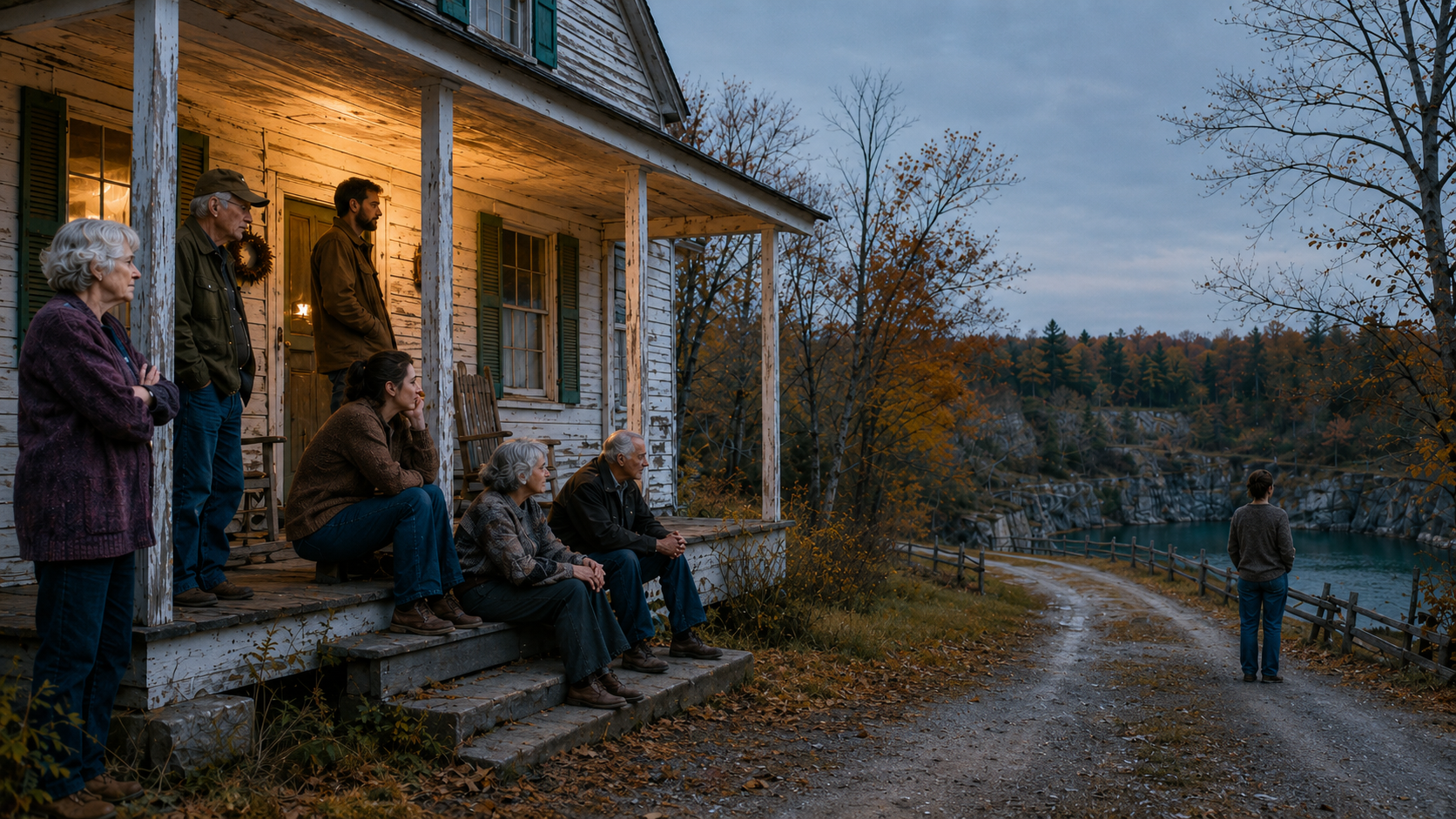
The empty house had a different sound. With the furniture gone the rooms gave back her footsteps and her breathing and the tick of rain on the windows, and the sewing room, with only the wardrobe and the shrouded dummy left in it, felt less like a room than a held breath.
Lila set her work light on the floor and angled it up so the bulb threw the wardrobe’s interior into hard relief. She pulled the shallow drawer all the way out and set it aside. She reached in and found the worn smooth place on the right, low down, and she pressed it, and the little catch let go with its soft wooden cluck, and the false back shifted toward her.
She got her fingernails into the gap and lifted, gently, the way you lift a thing that might be older than you and more fragile than it looks. The cedar panel came away in her hands. The smell rolled out, cedar and dust and something else underneath, faint and sweet and very old, that she could not name and that she would later understand was the ghost of dried flowers, of lavender or chamomile, sachets gone to powder decades ago.
The work light reached into the cavity.
It was a space perhaps eight inches deep and the full width and height of the wardrobe, paneled in cedar on every side, built with the same care as the rest of the piece, built to last and built to be missed. It was nearly empty. A rosary hung from a small brass hook on one side, ebony beads gone gray with handling, the corpus on its little crucifix worn featureless by a thumb. A bundle of letters tied with butcher’s string, the paper foreign, the ink the brown of old blood, the top one addressed in a language she could not read past the shape of it.
And on the floor of the cavity, dead center, where a kneeling woman’s hands would lay it down and take it up again, where her own grandmother had knelt in this cold room day after day for seventy years, sat a flat tin box.
It was the kind of tin a fancy biscuit or a Christmas fruitcake came in once, the painted lid gone to rust-flecked nothing, the corners soft with age. Lila lifted it out with both hands and was startled by how light it was, light as an empty thing, light as a held breath. She set it on the floor in the pool of the work light and knelt over it, and the rain came down on the dark window, and from somewhere far off she heard a sound that might have been the wind in the quarry trees and might have been nothing at all.
She did not open it right away.
She would think about that later, why she waited, why she sat back on her heels in the empty house with the tin in front of her and her grandmother’s rosary swinging gently to a stop on its hook. Part of it was the work in her, the archivist’s discipline, the voice that said document where you found it, photograph it closed, do this right. Part of it was something older and more animal. The certainty that once she lifted the lid she could not put back whatever came out. That her grandmother had built a false wall and a secret catch and had knelt here ten thousand times precisely so that this lid would stay shut, and that lifting it was a kind of breaking, a kind of trespass, against a woman who had asked her, with the last clear strength in her hands, to leave it alone.
There is nothing there, her grandmother had said. You understand me? There is nothing there.
Lila looked at the tin in the white light. It was so light. Maybe it was nothing. Maybe it was empty, a thing kept for the keeping’s sake, the way the old kept things. Maybe she would lift the lid and find dust and a dead spider and feel like a fool, and she could put the panel back and bag the room and finish the house and drive back to her empty life in the city and let the dead keep their own counsel.
She put her thumbs under the lip of the lid. The metal was cold. It had given way to rust at one corner, and it resisted her, the way a thing long shut resists, and then it eased, and she felt the seal of seventy years break under her hands with a small gritting sigh.
The lid came up half an inch. The cedar-and-lavender smell breathed out stronger, and under it now that other thing, the thing she had no name for, the smell of paper and cloth and time.
From down the hall, in the empty kitchen, the phone she had forgotten was even connected began to ring, loud as an alarm in the hollow house, and Lila’s hands jumped on the lid, and she knelt there in the white light with her heart slamming and the tin half open under her fingers.