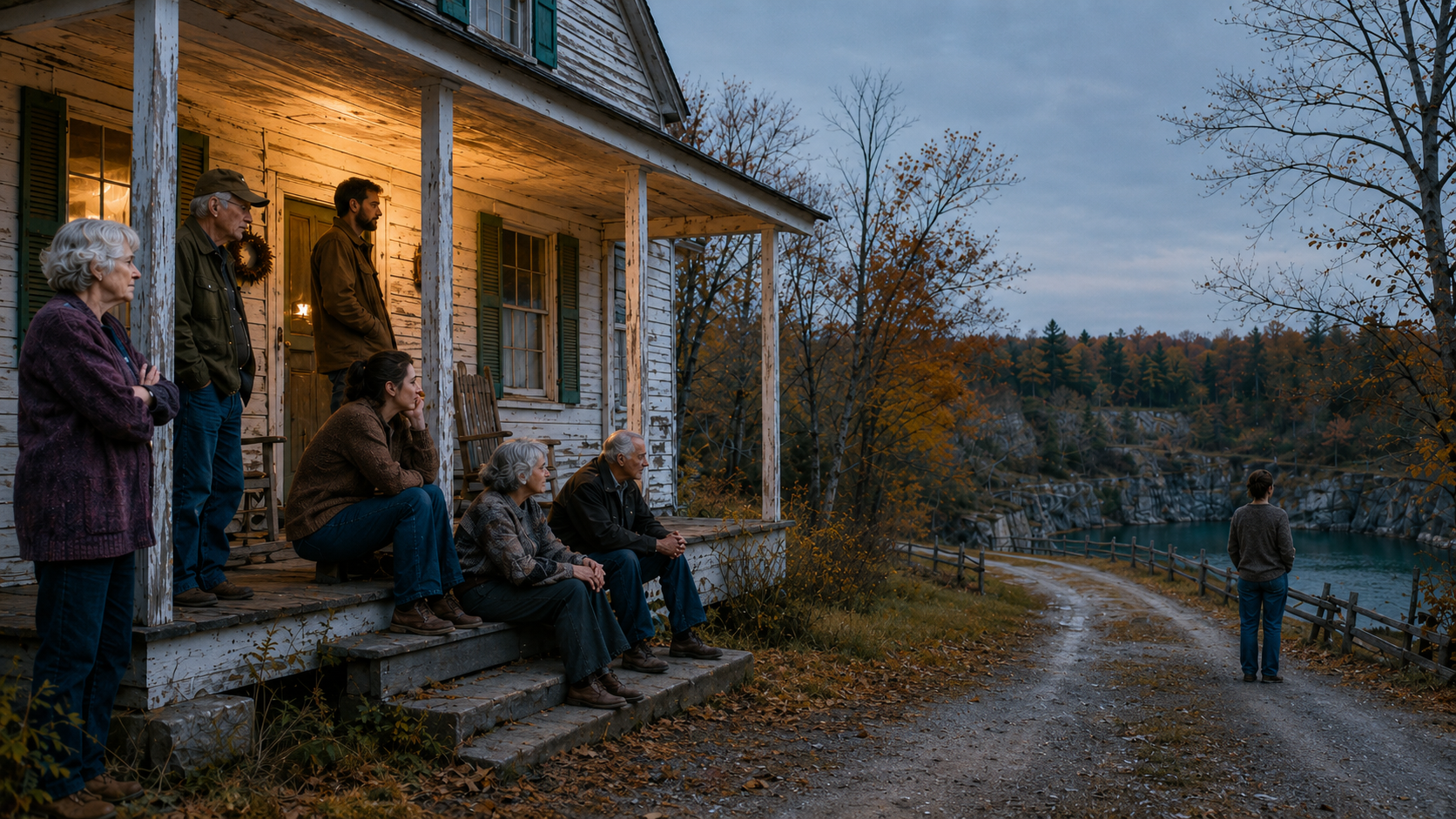
She made coffee because her mother had taught her that you made coffee when somebody came in from the cold with hard news, and she set a cup in front of Joseph Mazur and one in front of herself, and she did not turn on the radio for the polkas, because this was not that kind of kitchen tonight. He took the cup in both his big hands and warmed them on it before he drank.
“I will tell you the part Father Bryla does not have,” he said. “And I will tell you a part that no living soul has but me. You will need both to make sense of the second.”
“All right.”
“The first part,” he said, “is short. December of ‘forty-eight, your grandmother and I dug a hole on the parish strip, up at the bend, where the haul road turns. I dug most of it because she was eighteen and small and her hands were shaking. We put her boy in it. She prayed. I stood with my cap in my hand. I drove her to St. Hedwig’s at dawn. I sat at the curb until she came out of the rectory. I drove her home. I never spoke of any of it to anyone, not to my mother, not to my wife later, not to my son when he was old enough to ask, which he never did, not to a single soul living. Your grandmother and I stood near each other for seventy-eight years at the post office and in the narthex at Mass and at three funerals and one wedding, and we never said one word to each other about any of it, in any language. That is the part Father Bryla had. I have just given it to you. It is finished.”
“Yes, sir.”
“The second part.” He looked into his cup. “The second part begins in 1973.”
He took a slow breath.
“My boy was Peter. Peter Joseph Mazur. He was the only child we had, Genevieve and I. Genevieve was a fine woman, she came from the Slovak side of town, and she gave me the one child the doctor said we would have, and the boy was the world. He was sixteen years old in the summer of ‘seventy-three. He was tall like me. He was quieter than I was. He drew. He was going to do something with that, we thought. We were proud of him without saying so much, the way you were proud of a boy in those days.”
He took a swallow of the coffee.
“That summer he was in love with your mother, Lila. He never said so to me, but a father knows. She was fifteen. They had grown up next door to each other on this road, and they had been at the church school together, and at some point that summer they were not children anymore. They kept it to themselves, because of what they understood about the families, the way my house and your grandmother’s house stood near each other but never quite came into each other. They understood that without us telling them. They were not stupid children. They were trying to be careful with us, even while they were being kids.”
Lila set her cup down. She had not known this. There was nothing in her mother she had ever read as having been in love at fifteen.
“He went to the quarry pool on the night of the sixteenth of July, ‘seventy-three. He had told his mother he was going to a friend’s, and his mother had not asked which friend, because he was a good boy and she trusted him. He never came home that night. The state police found him at first light. The current at the bottom of the workings is bad, you know that, every kid in this town has been told. He had dived from the high ledge, where the boys had been daring each other since I was a boy, and he had not come up.” He paused. “The coroner ruled accidental drowning. The whole town agreed. There was no question, Lila. There was no foul play. It was a boy of sixteen showing off at a place we had all told them not to swim in. That was the whole of it.”
“But.”
“But.” He set the cup down. “That night, after Genevieve had finally gone down at three in the morning, I could not sleep. I had a feeling. The kind a parent has and tells himself is foolish and still gets up to walk around the house with. I went to the back upstairs window, the one that looks east across our field to the road, just to look. The sky was starting to gray. The road was empty as far as I could see, all the way to your grandmother’s house at the end. I stood there a long time.”
He looked at her now, the blue of his eyes very clear.
“And then I saw a small figure come around the bend by the parish strip and run down the road. Running. A small figure in light clothes. I could not tell, at that distance, in that light, if it was a man or a woman or a child, but it was small and it was running, and it was coming from where the haul road meets the gravel, from the quarry pool side. It ran along the gravel maybe forty yards and then it stopped and bent over, the way a person stops to catch a breath, and then it went on, and it went into your grandmother’s lane down at the end of the road, and I saw the porch light come on at your grandmother’s house, and then I lost sight of it.”
The kitchen was very quiet.
“Twenty minutes later the state police car came up the road from town with its lights going, and the trooper came to my door, and he told me about my boy.”
He stopped. He put his hand around the cup again, not to drink. Just to hold something.
“For fifty-three years,” he said, “I have wondered who that figure was. The state police took my Peter out of the pool and they ruled it accident. The next afternoon I came down here to this very house, to your grandmother and your grandfather, to thank your mother for going to her parents in the night and waking them, because your grandfather had called the state police, that was how the alarm went up. Your grandfather told me your mother had come into their bedroom at five in the morning saying Peter wasn’t home yet and she was worried about him, because she had said good night to him at the pool the evening before and he had stayed to swim and she had gone home and now it was almost dawn and he hadn’t come home, and her parents had her go back to bed and they had called the police themselves. That was the story. That was the story for fifty-three years.”
“But you saw her run down the road at first light.”
“I saw a small figure run down the road at first light. From the parish strip, where the quarry road bends. I could not tell, then, who it was. I have wondered every day since.” He looked at her. “I never asked your mother, Lila. I never asked your grandmother. I never asked anybody. Do you want to know why.”
“Yes.”
“Because of what I owed your grandmother. Because of December of ‘forty-eight. Because she had stood next to me with the lantern for an hour while I dug iron ground, and I had told her on a porch in the morning that I would not say a word about her hardest hour as long as she lived. And I understood, looking out my back window at the first light of the sixteenth of July, ‘seventy-three, that if that figure was her daughter, and if her daughter had been at the quarry pool with my Peter that night, then her daughter had her own hardest hour now, and that whatever I might be owed as a father did not give me the right to break the silence I had given her mother as a young man.” He shook his head. “I did not ask. I have not asked. I have made my peace with it. Genevieve died not knowing. I have been ready to die not knowing.” He looked up. “But I think you ought to ask her, Lila. Before your grandmother goes. Before I go. I think it is time. I think she has been carrying something on the same stretch of road, and I do not think it is right that the two of them should die without learning that they have been carrying it on the same ground.”
Lila could not speak.
She was thinking about her mother’s face, in the kitchen with the polkas yesterday, when the photograph went down on the cloth. She was thinking about the white-around-the-mouth instant she had not understood before, when she had made the joke about a body being buried up the road, and her mother had not laughed. She had thought it was Mikołaj her mother was hearing. She had been wrong about which dead.
“All right, Mr. Mazur,” she said. “I’ll ask her.”