Lila did not sleep. She sat up in the one chair left in the empty house with the photograph propped against the cold lamp and her mother’s words going around in her, leave her something, don’t you dare show that to her, she’s ninety-six. And against them, her grandmother’s own words, the only ones that mattered in the end. My son. Forgive me. A woman did not write forgive me and hide it for seventy years because she wanted to be left in peace. She wrote it because she was waiting, all that time, for someone to find it. For someone to come.
She drove to Cedar Run in the gray of the next morning before her courage could fail.
Stefania was at the dayroom window in her chair with the blanket over her knees, watching the parking lot fill with the cars of the day shift. She was somewhere far off that morning; Lila could see it in the loose way the old hands lay, in the slackness around the mouth, the fog rolled in thick. For a moment Lila almost turned around. Almost let her mother be right. Let her have her peace, the poor old thing, what good could the truth do a woman of ninety-six.
But she had come, and she was the only one who would, and she pulled the chair close and sat and took her grandmother’s hand.
“Babcia. It’s Lila.”
The blue eyes drifted to her and away.
Lila took the photograph out of the folder. Her hands were steady, the way they were steady over the most fragile things. She laid it in her grandmother’s lap, in the light from the window, and she put the old woman’s own hand on top of it, and she said, very softly, “Babcia. I found him.”
For a moment nothing. The fog. The parking lot. A cart rattling somewhere down the hall.
Then Stefania looked down at her lap, at the small gray photograph under her own hand, and Lila felt the change come up through her grandmother’s fingers before she saw it in her face, a stilling, a gathering, the fog drawing back like a tide going out fast off a flat shore. The loose hands tightened on the print. The slack mouth firmed. And the eyes that came up to Lila’s were not lost at all. They were the hard pretty blue, clear to the bottom, clearer than Lila had seen them in two years, and they were full, brimming, of a grief so old and so patient that it had simply waited, the way the parcel up the road had waited, the way the tin had waited behind its wall, for the day someone would finally come and lift the lid.
“Mikołaj,” Stefania said. She said it the way you say the name of someone in the next room. Mee-ko-why. “You found my Mikołaj.”
“Yes, Babcia.”
The old woman looked at the photograph a long moment, and her thumb moved over the small wrapped shape in the girl’s arms, over the gown, the way it must have moved ten thousand times in the dark behind the cedar wall. When she spoke again her voice was steady and low and entirely present, the voice of a woman telling, at last, after a whole long life of silence, the one thing she had been carrying.
“He came with me on the boat,” she said. “All that water. He was so good, he never cried. The other women said, that one, he knows already he must be quiet.” A breath. “It was so cold here that first winter. I did not know how cold America could be. The little house was cold and he took a fever, and the fever would not break, and there was no money for a doctor and I was afraid to bring one, I was afraid of the questions, you understand, a girl with a baby and no husband and no papers for him.” Her hand closed on Lila’s. “He died three days before Christmas. Nineteen forty-eight. In my arms, in the night, in that cold little house at the end of the road.”
“Babcia,” Lila whispered.
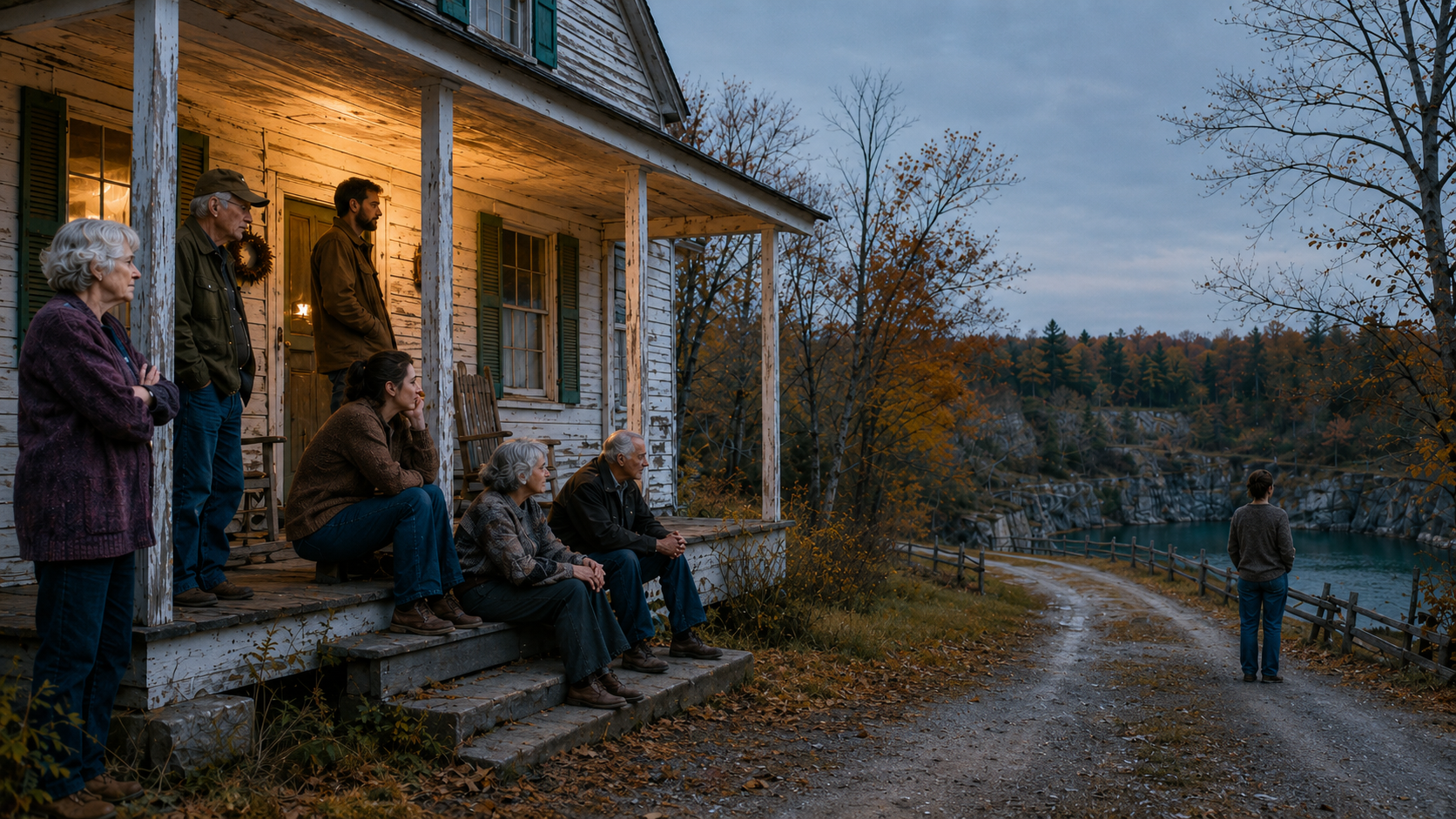
“I could not take him to the priest. I could not put him in the churchyard. How could I explain him? They would have taken him from me even in the ground, they would have asked and asked.” The blue eyes did not waver. “So Joseph helped me. Joseph Mazur, he was a good boy, he loved me and he asked no questions. We waited for a night with no moon and we carried him up the road, where the haul road bends toward the water, and the ground was like iron, Lila, like iron, it took us till the morning star. And we put him there, in his gown, with the box, the letters, his name. And I have gone up to that piece of ground every day of my life that I was able. To sit with him. So he would not be alone up there in the cold.”
She turned her hand over and held Lila’s between both of hers, and the photograph slid in her lap, and from somewhere came the rattle of the breakfast cart, the ordinary morning of the place, while seventy-eight years let go all at once in the quiet by the window.
“He is up there now,” Stefania said. “My boy. Where the road bends. That is what I would not let you sell. That is the nothing that is there.” A tear went down the deep-folded cheek and she did not wipe it. “You found him. After all this time, somebody finally came and found my Mikołaj.”
And Lila Tannenbaum sat holding her grandmother’s hands in the gray light of the dayroom and understood that the secret was real, and the grave was real, and that just up the quarry road, under iron ground at the bend toward the water, in a christening gown, with a tin box of letters in a language no one had read, lay a child who had been waiting seventy-eight years for his family to learn his name.