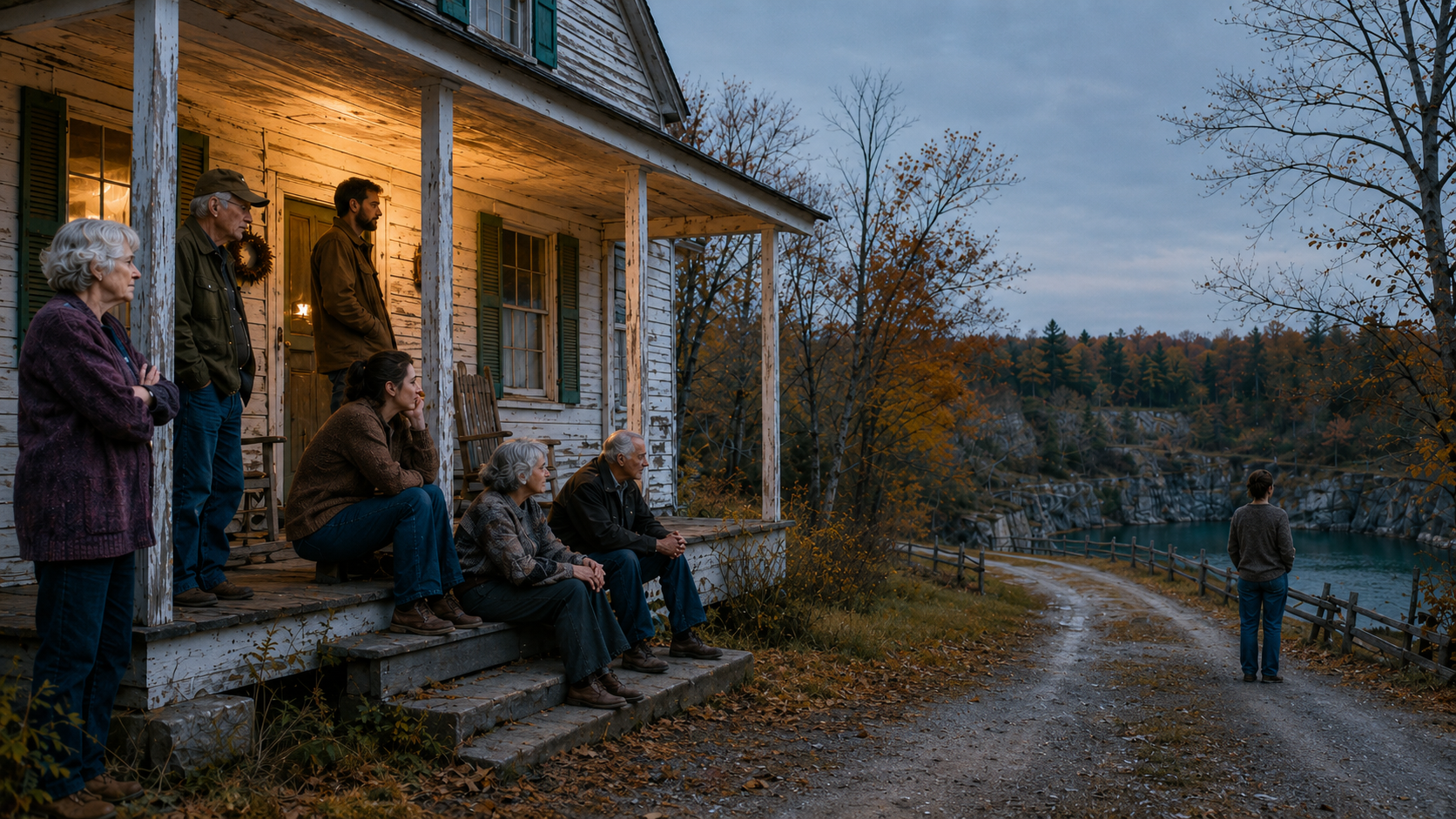
The hospice nurse called Father Karol at twelve minutes past seven that morning, while the family was still at the bend in the road. He took the call, and with permission, on the speaker, so that all of them could hear together at once. The nurse’s voice was tired and kind. Father Bryla had gone in his sleep just after the seven o’clock bell. She had been with him. He had not woken. His hand, when she had gone to take his pulse, had still been around the photograph.
Father Karol said the small prayer for the dead under his breath. Stefania closed her eyes. Joseph crossed himself with his cap in his hand. Rose put her arm around Lila and Lila put her arm around Rose and they stood at the bend in the road with the wooden box at their feet and the seventh bell of the morning still hanging in the cold air.
“He waited until we had him out, Karolu,” Stefania said quietly. “He waited until he knew. Then he could go.”
“I think he did, Pani.”
So the Saturday that had been the day of the reburial became also the day of the burial, and the parish of St. Hedwig’s, which had been making one small grave ready, made instead two together. Mr. Knapp and his nephew lifted the box again and carried it down the road to the parish hearse Father Karol had brought from the funeral home. They drove behind it down the gravel, then the asphalt, then the long block to the church. Lila drove Stefania in the parish van with Rose and Joseph. The November sun was up over the cement plant by the time they came into the lot at St. Hedwig’s, and the bells were ringing again, in the long full peal they rang for a death, and the long block was lined with the old people of the parish coming out of their houses in their coats, because the news of Father Bryla had moved through Sandstone Falls the way news moved in a town that small, by phone tree and by neighbor and by the bells themselves.
The Mass for Father Bryla was at ten. The church was full. Lila had not seen the church full in years. The old Poles were there in their coats and their hats. The Slovak side of the parish came over from St. Andrew’s because Father Bryla had baptized half their grandchildren. The bishop sent a young auxiliary who concelebrated with Father Karol, and the auxiliary spoke a homily that was kind and unfussy and that did not need to say very much, because everyone in the church had known Father Bryla and had known what kind of man he had been. Stefania sat in the front pew on the gospel side, in the wheelchair, with Rose on one side and Joseph on the other. Lila sat in the row behind, where her father had once sat at her grandfather’s funeral. They sang the old Polish hymn at the end. Lila did not know the words. Her mother knew the words. Her grandmother knew the words. Joseph knew the words.
Father Bryla went into the ground in the parish cemetery behind the church, in the priests’ row, beside Father Janowski, whom he had served as a young man. The bishop’s young auxiliary said the prayers. The bells rang again. The old Poles wept the way old Poles wept at the funeral of a priest, with their hats off and their faces composed and a great deal more sound coming out of their throats than they would have let come out at any other occasion in their lives.
Afterward, when the cars had gone, when the last of the parishioners had taken their casserole dishes home from the parish hall and the bishop’s young auxiliary had been driven back to the chancery, Father Karol came back out to the cemetery in his stole and his overcoat, with Mr. Knapp behind him carrying the small box in his arms. Stefania was in the chair under the wall, in the corner of the consecrated ground where the parish had set aside, in writing, a small space for the boy. Rose stood beside her. Joseph stood beside Rose. Lila stood beside Joseph. Mr. Knapp set the box down on the small canvas they had prepared. The nephew was not there; this was for family. The November sun was thin and clean.
Father Karol did the rite. He said it in Polish, and he said it in English, the small short rite of committal for a child of the parish. He blessed the box. He blessed the small hole that Mr. Knapp had opened that morning. He read out the name. Mikołaj Sikora. Beloved son of Marta and of Józef. Beloved son of Stefania Marciniak, who had carried him across the sea. Born at Wildflecken on the twenty-second of November, 1947. Died at Sandstone Falls on the twenty-second of December, 1948. Now committed, on the twenty-second of November, 2026, into consecrated ground, into the keeping of his parish, into the mercy of God.
Lila stood with her hand at her mother’s elbow and watched her grandmother. Stefania was holding Tadeusz’s letter in one hand and the small framed photograph from Father Bryla’s bedside in the other, and she was not crying. The blue eyes were clear and steady. The November light was on her hair. She looked, for a long moment, exactly like the eighteen-year-old girl in the gray photograph that had brought all of them here, only with seventy-eight years of America written her face now, and Lila understood that her grandmother had been waiting, since the morning of the twenty-third of December, 1948, for this exact moment, and that the patience of the long waiting was now coming down off her shoulders piece by piece in the November light.
Mr. Knapp lowered the box. Father Karol said the last prayer. Joseph stepped forward, with his cap in his hand, and took up the small handful of dirt from the pile and dropped it onto the wood with the soft clean sound that was the only right sound for that gesture. Then Rose. Then Lila. Then Stefania, who reached down out of the chair and let Lila guide her hand to the pile and lifted what her thin fingers could lift and let it fall, and the dirt went down onto the box with the dignity of something said.
The stone, ordered through the parish on Father Karol’s emergency authority, would not be in until December. For today, Mr. Knapp set a small temporary marker into the soil at the head of the grave, a plain pine cross with the name burned into it in clean letters. MIKOŁAJ SIKORA. 1947 to 1948. Beloved.
They stood with it a while. The bells of St. Hedwig’s, which had been ringing all morning, were quiet at last. Somewhere in the parish lot a car door closed and an engine started. Father Karol stood at the foot of the grave with his hands folded and let the family have the silence.
After a long time Joseph Mazur put his cap back on. He bent toward Stefania in her chair and he said, low, in his careful old-country Polish, “Stefciu. Domowy obiad. Pójdziemy do domu i zjemy razem coś ciepłego.” Stefcia. Home dinner. Let us go home and eat something warm together.
Stefania, ninety-six years old, in her wool blanket in the parish cemetery, looked up at the old man who had stood beside her for seventy-eight years without ever once being allowed to stand beside her properly, and she smiled, and she said, in their language, the answer she had not been able to give him in ‘forty-eight or in ‘fifty-seven or in any year in between.
“Tak, Józef. Pójdziemy do domu.”, “Yes Josef. We’ll go home.”