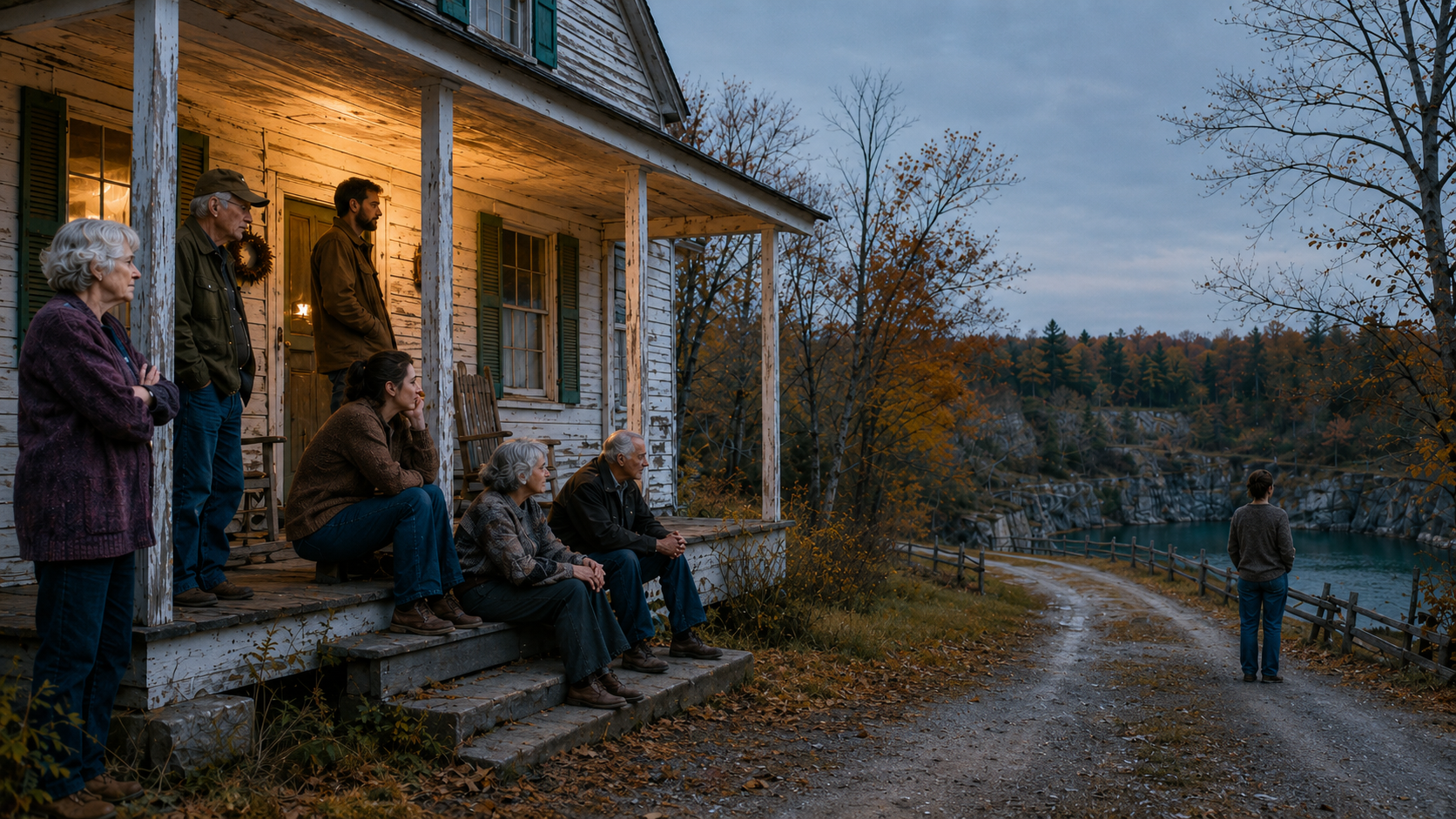
The day came clear and cold the way the forecast had promised. At six in the morning the sky east of Sandstone Falls was the pale gray that holds the first idea of pink. The bend in the road was screened from the highway by a stand of oaks, and the parish handyman, Mr. Knapp, had set up two work lights on stands, and the work lights threw the strip into a small bright stage in the half-dark. Stefania was in the wheelchair at the edge of the strip with a wool blanket over her knees. Joseph stood beside her with his cap in his hand. Rose stood beside Lila. Father Karol, in his black overcoat with a purple stole over it, stood with the small leather case the parish kept for things that had to be done outside.
Mr. Knapp and his nephew were a quiet pair of men, the older with gray under his cap and the younger with a beard he had grown that summer and was still embarrassed about. They worked in the careful silence of men who had been told, in the early light, that the small thing in the ground was a child of the parish from a long time ago, and that the family was here, and that nothing they saw at the bottom of the hole was to be spoken of in town under any circumstances. They had both nodded once. They had picked up their tools.
The ground was not iron. It had been a mild autumn. The frost had been only at the very surface. The spades went in clean.
It took them not quite an hour. They worked from the long sides toward the middle. They had marked the spot by Stefania’s directions, given quietly to Father Karol the night before, the directions of a woman who had walked this strip ten thousand times in her life and knew without thinking of it which arm-length from which knot on which oak the small flat place was. The nephew set the spade down at one point, and Mr. Knapp set his down a moment later, and the older man said, very quietly, “There it is.”
The wood at the top of the box was dark and a little soft, the corners gone to a felt of root and time, but it had held. It had held because Joseph Mazur, at nineteen, had used the camphor box his mother had had in the cellar, a tight-grained walnut with a fitted lid, and because the strip of ground he had picked was high enough above the water table that the box had only had to keep out damp, not flood. Mr. Knapp and the nephew got it up on lifting straps the way they got the small boxes up at the parish cemetery, slow and even, with the older man’s hand under one end the whole way, and they set it on the canvas Father Karol had spread on the lower ground next to the hole.
Mr. Knapp looked at the family. He nodded once. He and the nephew stepped back to the edge of the trees, out of the light, to give them the moment.
Father Karol crossed himself. He spoke the prayer of the Rite of Commendation in Latin and in Polish, low, and Stefania moved her lips with him on the Polish, the way old Polish people who had not heard the Latin Mass in a generation still followed the Polish responses by heart. He sprinkled the box with the small aspergillum from the leather case. He looked at Lila.
“You are the archivist in this family,” he said gently. “Will you open it.”
She had not known she was going to be asked. She knew, as soon as he said it, that he was right. She knelt on the canvas in the cold. The lid was held only by the original brass tacks, which had loosened in their seats over the years. She lifted it.
Inside, in the small protected dark, a folded piece of cloth covered the top of everything. White, gone to yellow, the soft ivory of an old gown. The other gown, Lila thought, the one Marta had begun. Below it, against the side of the box, a folded letter on the kind of thin onion-skin paper they had used in the camps. Below that, a small studio photograph in a thin cardboard mount, a young woman with dark hair and dark eyes, looking straight at the camera with the small unsmiling dignity of a refugee portrait. And tucked against the photograph, a folded card of stiff cream paper, the size of a Mass card, with a single dried sprig of something pressed inside it.
And under the gown, when Lila lifted it gently aside, the small wrapped shape of the boy, still wrapped, as they had laid him.
Lila closed her eyes a moment. When she opened them she did the work she had trained her whole career to do, which was the work of receiving a thing from the ground without breaking it.
“Father,” she said. “The card.”
He took it from her in his gloved hand. He opened it. He read it once to himself. He looked up at the family. His face was steady.
“It is a baptismal card from the camp chapel at Wildflecken,” he said. “It is dated the seventh of December, 1947. It bears the stamp of the chapel and the signature of the chaplain, Father Józef Wójcik, who I will note for the record was not related to your grandfather, it was a common surname. It reads, the certificate of baptism of one child, male, baptized Mikołaj, born the twenty-second of November, 1947, at Wildflecken. The parents are listed.”
He paused. He looked at Stefania. Stefania nodded once, the smallest possible nod, the consent she had given two days before in the family room at Cedar Run, the consent that had been given a lifetime ago in a sacristy at dawn.
“The mother,” Father Karol said quietly, “is given as Marta Sikora, born Marta Wieczorek in Lwów. The father is given as Józef Sikora, born in Stryj. Both deceased, by handwritten notation in another ink in the lower corner of the card.”
The cold air at the bend in the road did not move.
Joseph Mazur, who was a man who had spent seventy-eight years not asking, looked at the side of Stefania’s face and did not say anything at all. Rose’s hand went out and took Lila’s, the way it had not gone out and taken Lila’s in any of the moments of the last week when Lila had thought it might. Lila held onto her mother’s hand and looked at her grandmother in the wheelchair.
Stefania was not looking at any of them. She was looking down at the box. Her eyes were dry and steady. Her hand, on the blanket, was open with the palm up, the way you put your hand out for a thing you have been waiting to be given back.
“He was not yours by blood, Mama,” Rose said softly. Not as a question. As a thing she had finally understood. “He was not yours by blood, and you loved him as if he had been.”
“He was my son, Rose.” Stefania’s voice was very quiet, and the blue eyes were very clear, and the small bright stage at the bend in the road held still around them. “He was mine by blood, by every blood that matters, by the blood we left in the camp and the blood we carried out of it. The card has its parents. The card is right. And he was mine. Both things are true. I will tell you the rest of it now, all of you, if you will sit with me a little longer in this cold. I have been carrying it a long time, and I would like to set it down here, where I dug it in.”