Chapter 3/Episode 5: She Carried That Letter in Her Heart Since ’48
June 25, 2026 — 65Nation
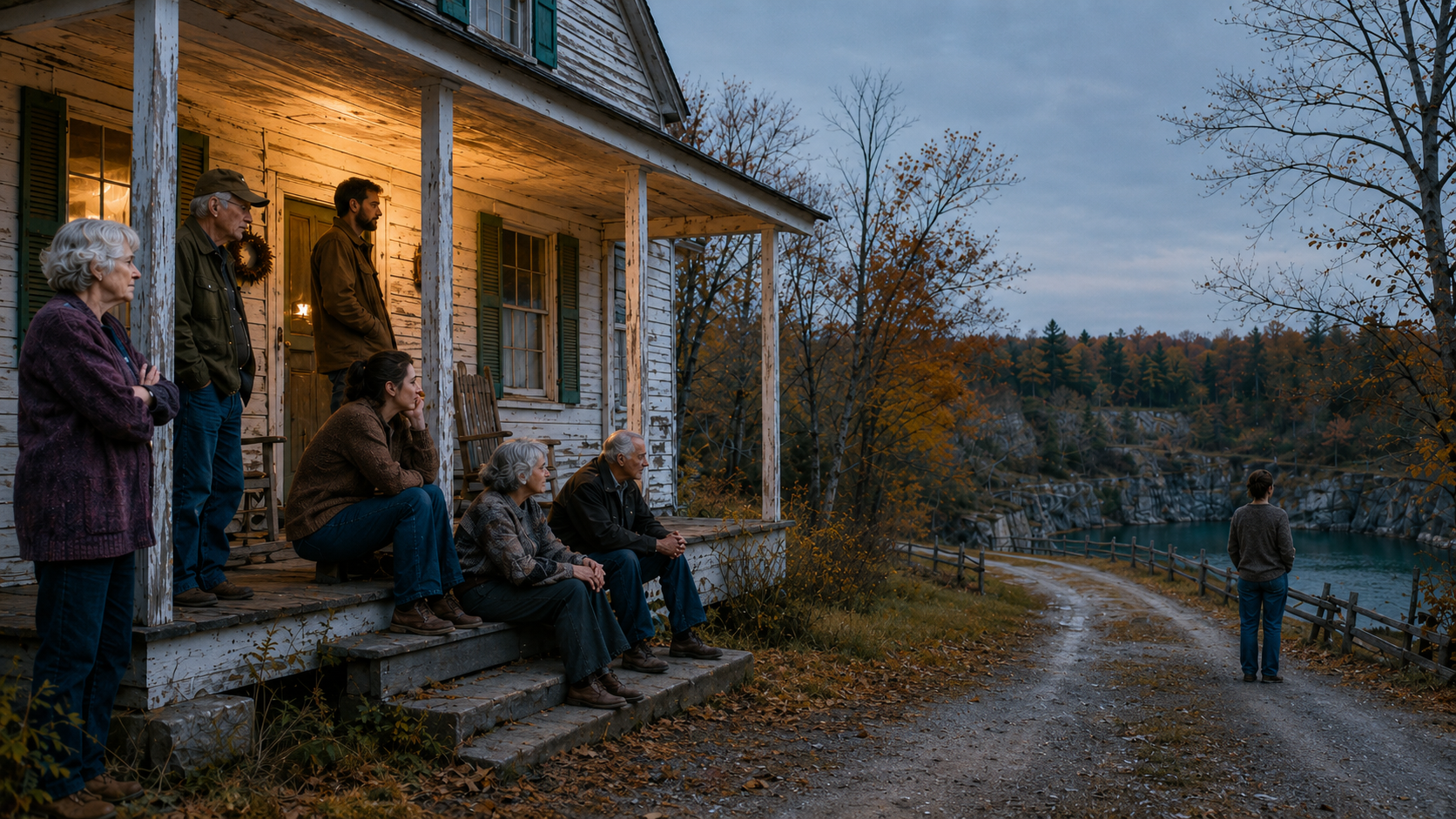
They wrapped her tighter in the wool blanket. Father Karol brought a folding chair from the trunk of his car and set it beside the wheelchair, and Rose sat on it with one hand on her mother’s hand. Joseph stood. Lila knelt on the canvas. Mr. Knapp and his nephew stayed back among the oaks. The work lights threw the strip into a small still room, and the box sat on the canvas at Stefania’s feet, and the November dawn went on coming up behind the trees.
“We were three girls in one barracks at Wildflecken, in ‘forty-six,” Stefania began. “Marta and me and a girl named Halina who went to England in the end and we lost touch. Marta was a little older. Twenty-two when I met her, twenty-four when she died. From Lwów, before the war. She had finished a year at the gymnasium and she could read German and a little Latin, and she had come through the war the way a person comes through a fire and is still polite to everyone afterward, you understand. She was the dearest person I have ever known. She was my best friend. She had married Józef Sikora in the camp in ‘forty-six, in the chapel, because Józef had been her neighbor in Stryj when they were children and they had found each other again in the camp, the way people did. They were a quiet couple. They did not say much. They were each other’s only living person.”
She looked at the photograph in Father Karol’s gloved hand, at the dark hair and the steady eyes.
“In the summer of ‘forty-seven Marta was expecting. The doctor at the camp said she should not have been able to, because of what her body had been through in the war, but God arranges what He arranges. Mikołaj was born in November of ‘forty-seven, in the small infirmary at Wildflecken, with me beside her holding her hand because Józef was not allowed in the room, that was how the Americans did it. He was small. He was strong enough. We had him.
“In the spring of ‘forty-eight Józef took sick. The chest. There were many sick that spring at the camp, the winter had been bad. He went quickly. Marta sat with him in the infirmary until the end. She came back to the barracks with the baby and she sat on her cot and she did not cry, the way Marta did not cry about things. She said to me, in our language, she said, Stefciu, my Józef is gone, and I am going to follow him, and I am asking you a thing that you are not going to be able to say no to. I am asking you, when I go, to take this boy as if he were yours. I am asking you to claim him. I am asking you to go on the ship with him and to say in America that he is your son, because if you do not say so, there is no one for him, and they will put him in an orphanage, and a Polish boy in an American orphanage in ‘forty-eight will not be a Polish boy by the time he is six. Will you take him, Stefciu. And I said yes. I said yes before she had finished. I said it from inside the love I had for her, which was the deepest love I had ever had for a woman in my life, and I said it from inside another love too, which I had not yet told her and which I will tell you now.”
She took a breath.
“There was a man at the camp named Tadeusz Kowalski. He had been in the resistance during the war and the Germans had broken him for it. He had gotten out in ‘forty-five with his lungs were ruined. He was in the infirmary much of his time at Wildflecken, with the TB. I had been visiting him for two years when Marta was carrying Mikołaj. We had not married. He thought he could not, because of the lungs. He had asked me. I had said yes anyway. Father Bryla, who came to the camp twice from his diocese in ‘forty-seven before he went to America, knew about the engagement. Tadeusz and I were going to be married in the camp chapel in ‘forty-eight when we got the visa together. He had a visa coming. He had a cousin in Detroit. He had not gone to Mass because he had not been able to keep his food down for two years, and I had brought him soup and read to him in the afternoon and sat with him many days when he could not talk.”
She looked at her hands.
“Tadeusz died in May of ‘forty-eight, six weeks after Józef Sikora. They went the same way, on the same ward, with the same chaplain saying the same prayers over them. He left me a letter. He gave it to me in the last week. I have it under the gown there, in the box, in his handwriting, and Father Karol, if you will take it out, I have not opened it since the night we put him in the ground in ‘forty-eight, and I would like to hear it read once more, in this November, before we take Mikołaj down to the church.”
Father Karol took the letter out with great care. The paper was thin and soft. The folds had not broken. He unfolded it. He read first to himself. He looked up at her. He read it aloud, in Polish, slowly, so that even those without much Polish could hear the music in it, and then he translated each line in English, also slowly.
It was a short letter. It said: Stefcia, my love, when you read this I will be in the country where there is no more lung. Do not stay too long in the camp. Take the ship. Take the visa. Take the new country. Build a life for yourself there with a man who is well, who will be kind to you, who will give you children with their feet on the ground. The boy, your Marta’s boy, will be your son in America. Love him for me, for I would have liked to be a father, and I would have liked him to call me uncle, and that is not granted us, but love him as your own and tell him about his mother and his father and tell him about me only if you wish to. I leave him to you because there is no one else, and because Marta has asked me to second her in this, and I do, with all my heart, second her. He has Marta’s eyes. He has Józef’s chin. He will have a Polish soul wherever he goes. Take care of yourself, Stefcia. Take care of him.
T.
Father Karol’s voice steadied at the end. He folded the letter back along its old folds and gave it to Stefania, who held it in her hand a moment and then handed it to Joseph, of all people, who took it because he could not refuse it and held it in both his hands while she went on.
“So that was what I knew,” Stefania said. “I knew Marta was his mother and Józef was his father. I knew Tadeusz wanted me to take him for the love of all three of us. I knew I had a child entrusted to me by the dearest people I had ever had. And when the visa came in October of ‘forty-eight, and I went to Father Bryla, the young Father Bryla, in Bremerhaven, where he met us on the paper to take us across, I told him in confession on the boat that I was bringing a boy who was not mine by birth but was mine in every way that mattered, and that I was going to present him as my son in America, and that I was sorry to ask any priest to be quiet about a thing like that, and Father Bryla said to me, child, if you ever bring me anything that is harder than this, I will tell you so then, but for now this is not so hard. And he was as good as his word in ‘forty-eight, and he has been as good as his word for seventy-eight years, and he is keeping his word in his rectory bed today. And when Mikołaj died here in ‘forty-eight, in this house, I told Joseph nothing of the camp story, because I had given Marta my word that the boy would be mine in America and I would not be the one to take it back from him in his grave. Joseph, you did not know. You buried a child you thought was mine. You were right. He was mine. And he was theirs too. The card has the truth on it. I have the truth in me. The two are not at war with each other. They never have been.”
She closed her hand around Tadeusz’s letter, which Joseph had given back to her without a word, and she sat in the wheelchair in the small bright stage of the work lights with her family around her, and the November dawn finished coming up behind the trees, and somewhere down in the town the bell at St. Hedwig’s began the seven o’clock peal for the first weekday Mass that Father Karol would not be saying that morning.
“Bring him home now, Karolu,” she said. “Bring him down to the church.”