Chapter 2/Episode 4: The Cold Little House at the End of the Road
June 10, 2026 — 65Nation
She comes in the dark in the back of a black sedan with the windows fogged from the inside, and the man at the wheel is a stranger named Mr. Cieślak from the parish, and the priest beside him, the young one, the one who met them in Bremerhaven on the paper and again in New York at the pier and now once more at the train, the young one with the kind blunt face, half-turns toward her in the front seat and says, in good clear Polish, “Pani Stefaniu. We are almost there. The widow is a good woman. Do not be afraid of her.”
She is not afraid of the widow. She is afraid of all the rest of it. The road outside the window. The smell of this country, gasoline and wet leaves and something faintly mineral that she does not know yet is the smell of limestone dust off the cement plant. The wet pavement. The dark trees. The way the houses sit so far apart out here, with so much black field between them. In her arms Mikołaj has been asleep for an hour, hot against her collarbone, his small breath puffing under her ear, and she is afraid even to shift him because if he wakes, in this car, in this dark, in this country, she will not know how to comfort him in a way that does not give them all away.
Mr. Cieślak turns up a gravel lane. Stones knock under the chassis. Quarry Road. The priest, the young Father Bryla, has said the name to her twice now, in case she should need it, in case anyone should ask her where she lived. Quarry Road. She turns it over in her mouth without saying it. Trzeba zapamiętać. She must remember.
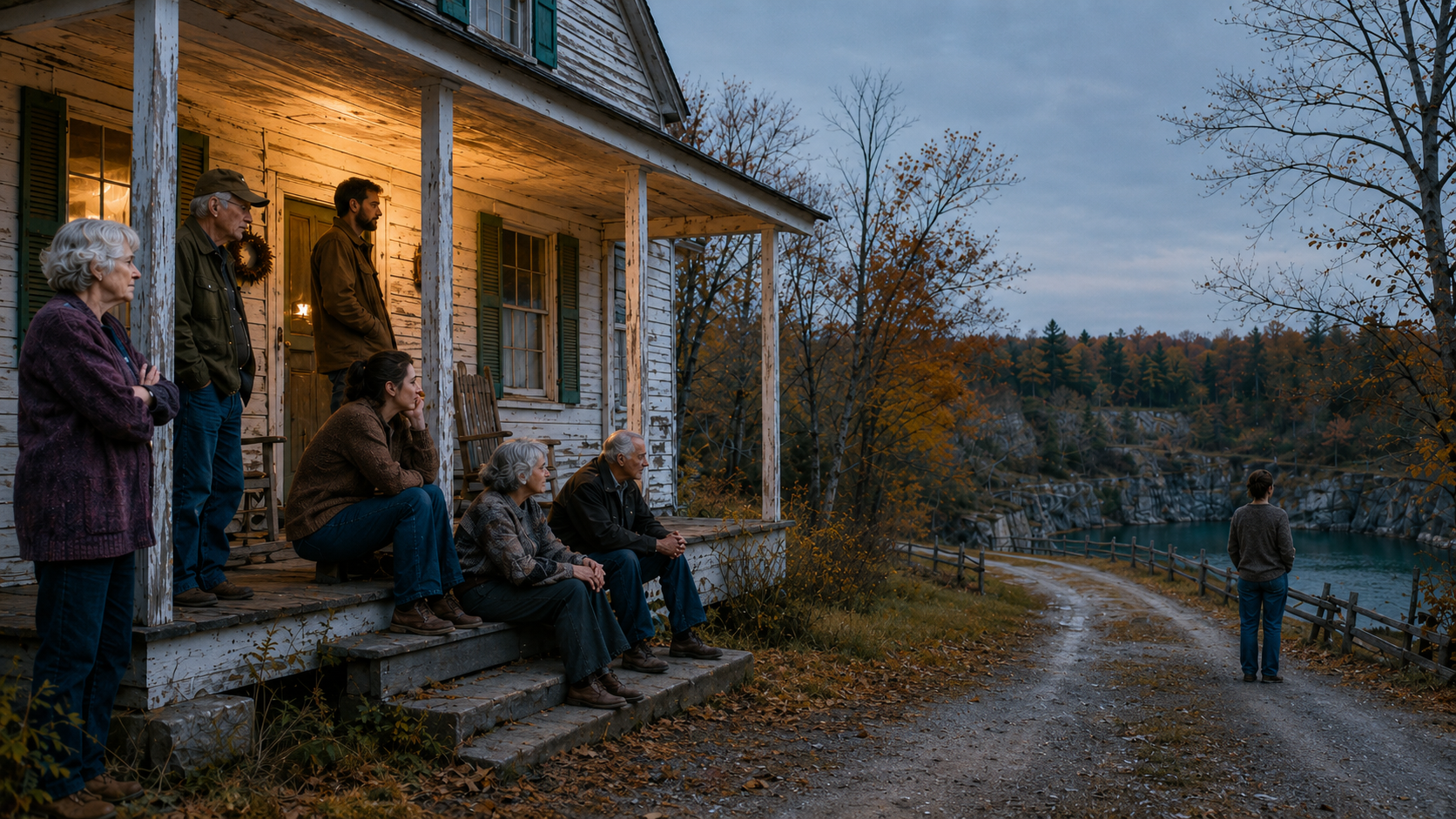
The car stops at the last house. A small white-painted frame house with a porch that already sags on one side. A lamp burns yellow in a window. The door opens before the car door does, and a small woman in an apron stands in the doorway with one hand to her throat, peering out into the headlights.
“Pani Bartos,” Father Bryla says, getting out. “She is here. They are here.”
The widow comes down the steps. She is short and round and her hair is a careful gray bun, and her eyes are wet in the headlights, and she is reaching for the baby before she has so much as said a word to Stefania, and Stefania, after one stunned second, lets her have him.
“O Boże,” the widow whispers. She rocks the small hot weight of him as if she has been waiting all night to hold him, which it occurs to Stefania, half-mad with tiredness, that perhaps she has. “O moje dziecko.” She looks up. “Pani Stefaniu, come in. Come in. The water is on the stove. Father, the bag is in the car. Bring the bag. Come in.”
The kitchen is small and warm and smells of cabbage and dill, the same smell as every Polish kitchen she has ever stood in, and the sameness of the smell catches her behind the eyes. She has not cried since the camp. She does not cry now. The widow gives Mikołaj back to her and pushes her gently into a chair at a little oilcloth-covered table and puts tea in front of her, in a glass, in a metal holder, the way her own grandmother once did it, and Stefania sits with the baby and the glass and looks at the strange clean orderly kitchen and does not know how to begin to be there.
“You will be tired,” Pani Bartos says, in Polish, the kindly bustling Polish of a woman who has been waiting all evening to have someone to fuss over. “You will eat tomorrow. Tonight just sleep. There is the back room, with the iron bed and a basket I have made for the little one. He will sleep next to you. Father has told me everything I am to know, which is nothing about anybody, which is fine with me. We will mind our business and learn what each other is like. There is no rush.”
Father Bryla is in the doorway. He has not come into the kitchen. He has the look of a man who has worked all his life around women’s spaces and is comfortable on the threshold of them.
“I will come Friday, Pani Stefaniu. To see how you are. And on Sunday, of course, at the Mass.” He hesitates. “If you want me sooner, there is a telephone at the rectory. Pani Bartos has the number. You only need to send word.”
“Thank you, Father.”
“You are welcome, child.” He looks at her for a moment longer than the small courtesy calls for. He has heard her in confession only once, on the boat, in a small crowded cabin in rough seas, the kind of confession that comes out of a girl who has been carrying everything alone for too long, and he has heard nothing of her since but small ordinary things. He knows. He does not say what he knows. She loves him for it the rest of her life.
“Good night, Father.”
“Good night, Pani Stefaniu.”
The car backs down the lane. The lights go small. The widow shows her the back room with the iron bed and the basket and the lamp on the dresser and goes away, and Stefania puts Mikołaj down in the basket and watches him not wake, and lies down on top of the quilt fully dressed, and listens to the house.
It is so quiet here. After Wildflecken. After the boat, where there was the sound of the engines and the sound of all those people, the breath of two thousand people in iron rooms. Here there is only the tick of the cooling radiator and the small huffing breath of the baby in the basket and, outside, very far away, a single dog barking once and giving it up.
She is almost asleep, in the way of a woman who has not slept properly in weeks and whose body has finally given her permission, when she hears it.
Footsteps on the gravel.
Slow ones. Coming up the lane toward the house. A man’s footsteps, by the sound, unhurried, deliberate. She is bolt awake in an instant, the way the camp taught her to wake, her hand already on the edge of the basket. The footsteps stop at the foot of the porch. She hears the small creak of a board taking weight, and then nothing, for what feels like a long time, while she stares at the dark window and her heart goes in her ears.
Then a soft tap at the kitchen door. Three knocks. Friendly enough on the face of them, the way a neighbor would knock. But the hour is past eleven, in a country she does not yet know, in a house full of women, and Pani Bartos has gone upstairs, and the lamp in the kitchen is still burning, and somebody is on the porch at this hour, in this dark, asking to be let in.