
New Blood Pressure Rules for Seniors and How to Check Yours at Home
October 26, 2026 — 65Nation
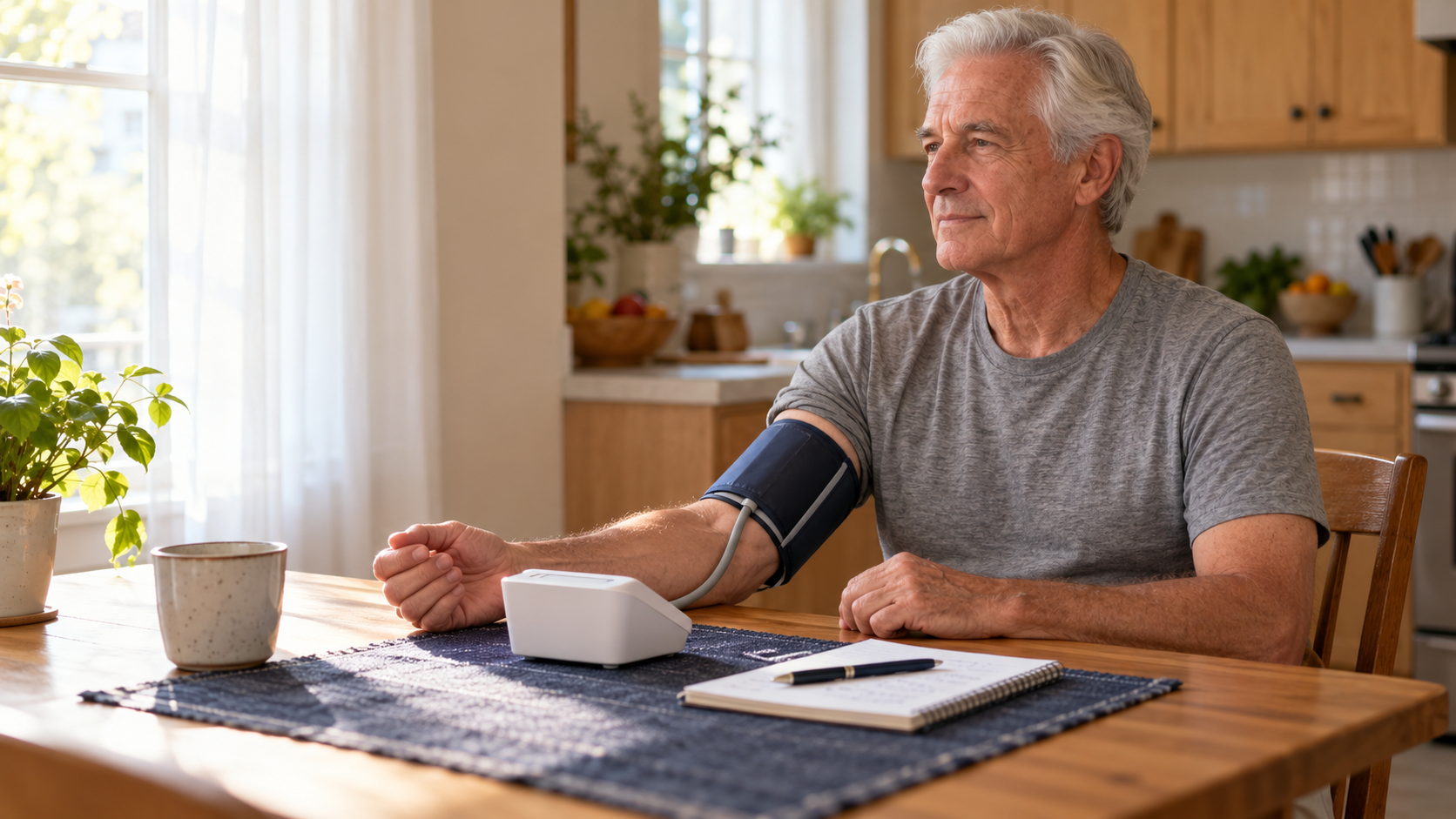
Most of us know our blood pressure the way we know the mileage on the car. A number somebody read to us once, at a visit we half remember.
That approach got harder to defend this year. In August 2025, the American Heart Association and the American College of Cardiology released their first major rewrite of the high blood pressure guideline since 2017, with twelve other medical groups signing on, including the American Geriatrics Society. It moves treatment earlier, puts the brain squarely in the conversation, and makes a home blood pressure cuff central to the plan.
Here is what changed, and what to do about it at your kitchen table.
The Numbers Did Not Move. The Urgency Did.
The categories have not changed since 2017. Normal is below 120 over 80. Elevated is 120 to 129 on top with the bottom number under 80. Stage 1 high blood pressure is 130 to 139 over 80 to 89. Stage 2 is 140 over 90 or higher.
The goal is also unchanged: below 130 over 80 for nearly all adults.
What moved is how soon doctors are told to act. Medication plus lifestyle changes is now recommended for anyone averaging 140 over 90 or higher. In the 130s over 80s, medication comes sooner for people with heart disease, a prior stroke, diabetes, kidney disease, or a higher calculated heart risk. Everyone else in that range gets three to six months of lifestyle changes first, then medication if the number has not come down.
Why the Brain Is Now Part of It
The guideline links high blood pressure to cognitive decline and dementia, and it recommends early treatment, with a top number below 130, specifically to help prevent them. The National Institute on Aging says the same thing in plainer words. Uncontrolled high blood pressure can lead to heart disease and stroke, and also to vascular dementia, eye problems, and kidney disease.
That matters for people our age more than anyone. The CDC’s most recent national survey found that 71.6 percent of adults 60 and older have high blood pressure. Fewer than three in ten of them have it under control.
The Case for a Cuff at Home
This is the practical heart of the guideline. Home monitoring, done correctly and shared with your care team, is described as an important tool for getting blood pressure under control.
A home cuff can tell your doctor something the office visit cannot. Dr. Kenny Cole, an internist and medical director for Ochsner Digital Medicine, explained it to the American Medical Association. White coat hypertension is when your pressure runs high at the office but normal at home. Masked hypertension is the reverse: normal at the office, elevated at home. The second one carries higher heart risk, and home readings are the ones that line up with long-term outcomes.
One warning the guideline makes explicit. Cuffless devices, including smartwatches, should be avoided for blood pressure readings until they prove more precise and reliable. A real cuff on the upper arm is still the standard.
How to Take a Reading That Counts
A home reading is only useful if it is taken the way a clinic would. The CDC’s instructions are short.
- Do not eat, drink, exercise, or smoke for 30 minutes beforehand.
- Empty your bladder.
- Sit in a chair with your back supported for at least five minutes.
- Both feet flat on the floor, legs uncrossed.
- Rest your arm on a table so the cuff is at heart level.
- Cuff on bare skin, snug and properly sized. The AMA’s Dr. Michael Rakotz is blunt about this: if the standard cuff does not fit, the device will not give accurate readings.
- No talking during the measurement.
- Take at least two readings, one to two minutes apart, at the same time each day.
The AMA suggests morning and evening readings for a week, which gives your doctor 28 numbers instead of one. Write them down, even if the device stores them, and bring the log to your next visit.
When you shop for a monitor, look for one on the U.S. Blood Pressure Validated Device Listing, established by the AMA and reviewed independently. Validated means it has been clinically tested and shown to give accurate readings. The AMA recommends an upper arm cuff that inflates automatically.
Two Things Specific to Our Years
The NIA points out that the most common form of high blood pressure in older adults is a high top number with a normal bottom number, caused by arteries stiffening over time. It is treated the same way, though it may take more than one medication.
And a caution in the other direction. Pressure that drops too low, sometimes from medication or dehydration, can cause lightheadedness, weakness, or fainting, which raises the risk of a fall. The NIA’s advice: get up slowly, and stand for a moment before you walk. If home readings run low, or you feel dizzy when you stand, call your doctor. A dose may need adjusting.
When a Number Is an Emergency
If a reading comes in above 180 over 120, the American Heart Association says to wait at least a minute and take it again. If it is still that high and you feel fine, call your doctor’s office as soon as possible. If it comes with chest pain, shortness of breath, back pain, numbness, weakness, a change in vision, or difficulty speaking, call 911 and do not wait to see whether it comes down.
The Bottom Line
The 2025 guideline asks less of you than it might sound. Know your number. Know the goal is under 130 over 80. Take it at home, correctly, with a cuff on your arm rather than a watch on your wrist. Bring a week of readings to the person who can act on them.
Seven days, two readings a day, five minutes each. That is the whole assignment.