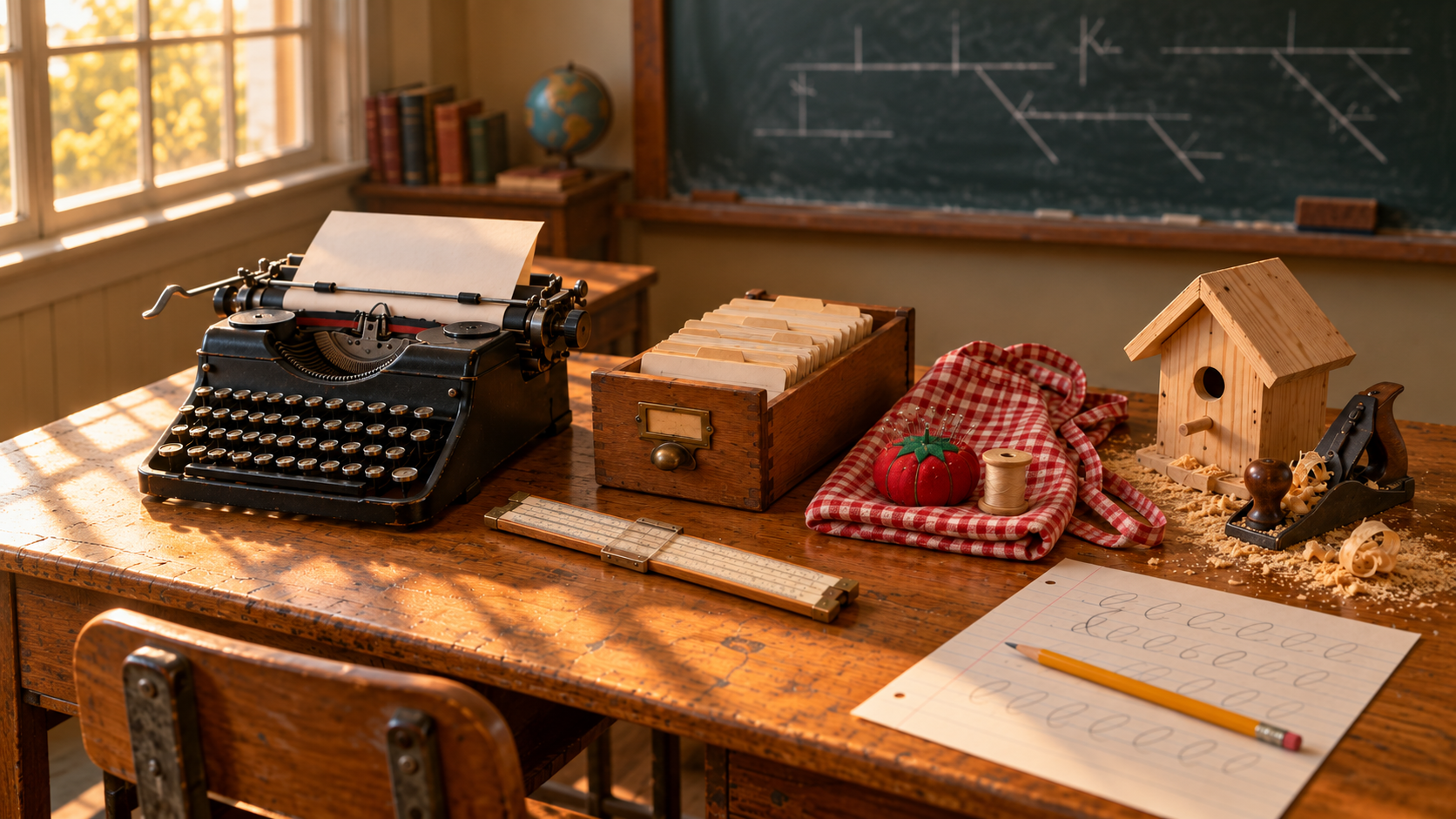
Think back to a school day in the 1960s. First period, you hunched over a manual typewriter with a cover taped over the keys. Later, you hemmed a skirt in home ec or squared up a piece of pine in shop. In gym, the teacher put on a fiddle record and told you to swing your partner. On the way home you stopped at the library and pulled open a little wooden drawer to find a book.
Here is something worth knowing: almost none of that happens in an American classroom today. Some of it was replaced by something better. Some of it simply slipped away. And one piece, as you will see, is on its way back.
1. Typing Class
The room clattered like a hailstorm; the keys were covered so you could not peek, and the manual typewriters had seen a few graduating classes before yours. For decades, typing was one of the most practical electives in the building.
Today the skill is called keyboarding, and it is rarely a class of its own. In a 2024 EdWeek Research Center survey, fewer than one in five school leaders said their schools teach keyboarding as a standalone course. Most students pick it up inside other classes, or on their own, which is why so many of them hunt and peck with two fingers. Researchers have found that method tops out at about 35 words per minute. Anyone who passed Typing II can beat that without looking down.
2. Home Economics
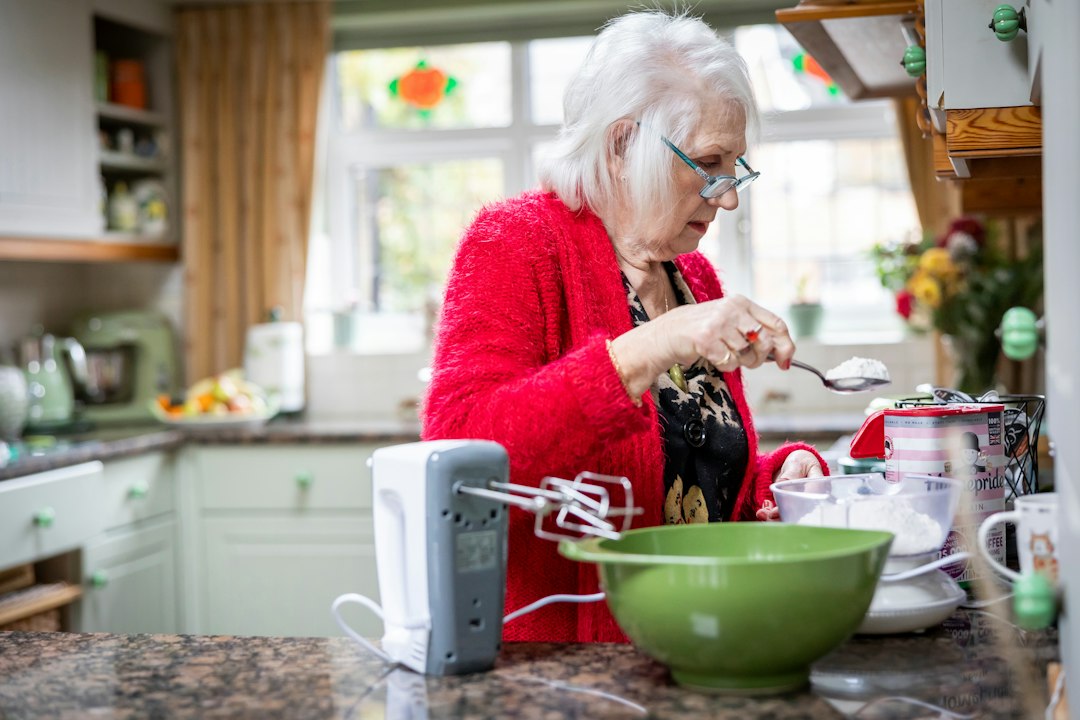
Measuring flour, threading a bobbin, balancing a household budget. In 1959, only 1.3 percent of the students in home economics were boys. Girls took home ec, boys took shop, and that was simply how the schedule worked.
The subject was renamed family and consumer sciences in 1994, and the new name did not stop the slide. A national survey published in the Journal of Family and Consumer Sciences found enrollment fell from 5.5 million students in 2002 to about 3.5 million a decade later, a 38 percent drop. Teachers told NPR they now spend class time explaining how to wash dishes and how to tell a teaspoon from a tablespoon.
3. Shop Class
The smell of sawdust. A birdhouse, a bookend, a lamp that mostly worked. Wood shop, metal shop and auto shop were where many of us learned to respect a tool.
The federal numbers tell the story. The National Center for Education Statistics found the average high school graduate earned 4.2 credits of career and technical coursework in 1990 and 3.6 by 2009. Budget cuts and a shortage of shop teachers did the rest. Once a shop was mothballed, the tools tended to disappear, and bringing one back meant starting from nothing, as one California middle school found when it reopened its woodshop after eight dark years. Some schools now offer 3D printers and laser cutters instead, which is a fine thing. It is just not the same as planing a board by hand.
4. Driver’s Ed in the School’s Car
Remember the sedan with the extra brake pedal on the passenger side, and the nervous teacher who used it? For a generation, learning to drive was something your high school did, usually at no charge.
Then came a run of studies in the late 1970s and early 1980s that could not show that students who took driver’s ed had fewer crashes. The National Highway Traffic Safety Administration dropped it from its priority list, the federal money went away, and states followed. California alone went from about 250,000 students getting behind-the-wheel training through public schools in 1990 to 440 students in 2007. The job moved to private driving schools, and the bill moved to parents.
5. The Slide Rule
If you took physics or engineering, you carried one in a leather case and could multiply, divide and pull a square root in seconds. The people who designed bridges, radios and spacecraft did it with the same tool.
Then the pocket calculator arrived. Keuffel & Esser, the largest American maker of slide rules, built its last one on July 11, 1976, and sent it to the Smithsonian. Nothing replaced the slide rule in the classroom. The calculator simply made it unnecessary, and a skill that took weeks to master became a museum piece in under a decade.
6. The Card Catalog
Every library had one: a wall of small wooden drawers, each packed with typed index cards sorted by author, title and subject. We learned the Dewey Decimal System so we could walk from the drawer to the right shelf.
The cards did not go quietly. OCLC, the Ohio organization that printed catalog cards for libraries nationwide, was shipping eight tons of them a week at its peak in 1985. It printed its last cards on October 1, 2015, after more than 1.9 billion in all. Most libraries had gone digital long before then, but that day was the official end.
7. Diagramming Sentences
Subject on the left, verb on the right, a vertical line between them, and the modifiers hanging off at a slant like laundry on a line. Diagramming dates to 1877, when two Brooklyn professors, Alonzo Reed and Brainerd Kellogg, argued that students would understand grammar better if they could see it drawn.
It held on for a century. In 1985, the National Council of Teachers of English declared that repetitive grammar drills got in the way of better writing, and diagramming faded from most classrooms soon after. Kitty Burns Florey, who wrote a history of the practice, says there are two kinds of people: the ones who loved diagramming and the ones who hated it. Both groups can still do it.
8. Square Dancing in Gym Class
Allemande left. Promenade home. If your gym teacher made you do-si-do to a scratchy record, you can thank Henry Ford. Ford loved old-fashioned dancing and, with a dance master named Benjamin Lovett, began teaching it to Dearborn schoolchildren in 1925. By 1928, close to half the schools in the country had square dancing in physical education.
It stayed on the gym calendar for decades and was eventually named an official state dance in more than 20 states. It has faded from most gym classes since, and for most kids today the do-si-do is something they have never done. It was good exercise, and you learned to look a partner in the eye.
9. Cursive (The One Coming Back)
We spent the third grade looping capital Q’s that looked like the number 2. Then in 2010, the Common Core standards adopted by most states left cursive off the list, and many schools stopped teaching it.
Here is the twist. Parents, teachers and lawmakers pushed back. In 2016, 14 states required cursive. As of this year, more than 25 do, including California, Florida, Michigan and Pennsylvania. Reading a grandparent’s letter, signing your own name, making out the Declaration of Independence: it turns out those still matter. On this one, the kids are catching up to us.
None of this is a knock on today’s schools. Kids are learning things we never did, and some of what we learned belonged to its time. But a generation that can type without looking, hem a pair of pants, find a book in a card catalog and square dance on command has a few skills no longer taught in schools that are still worth keeping. Pass one along this week. Someone younger might even thank you.