
A grandmother's strange rule about one strip of land.
Morning made the house ordinary again, the way mornings do. Lila stood at the north window with her coffee and looked at the worn place in the dust and felt a little foolish for the night before. An old house. An old woman who had lived alone too long with a part-time aide and a daughter who came Tuesdays and Fridays. People left marks. That was all a house was, in the end, a record of the marks people left.
She started in the dining room because it was the easiest, the room nobody had used since Henryk’s funeral lunch. China in the breakfront, the good Polish glass, a tablecloth gone the color of weak tea. She wrapped the cups in newspaper and stacked them in a box marked KEEP-ROSE in the careful block letters she used at work, and she let her mind go quiet, and for an hour it was almost pleasant.
The deed was in the second drawer of the breakfront, under the linens, in a manila envelope soft as cloth from handling.
She would not have read it except that her grandmother’s name leapt off the top fold in a typeface from another era. WOJCIK, STEFANIA M. She unfolded it on the table. A property description in the dense language of the county recorder, metes and bounds, a survey of a parcel of one and six-tenths acres, and a name for it that someone had typed and that someone else, in pencil, in her grandmother’s hand, had underlined twice. The Quarry Road parcel.
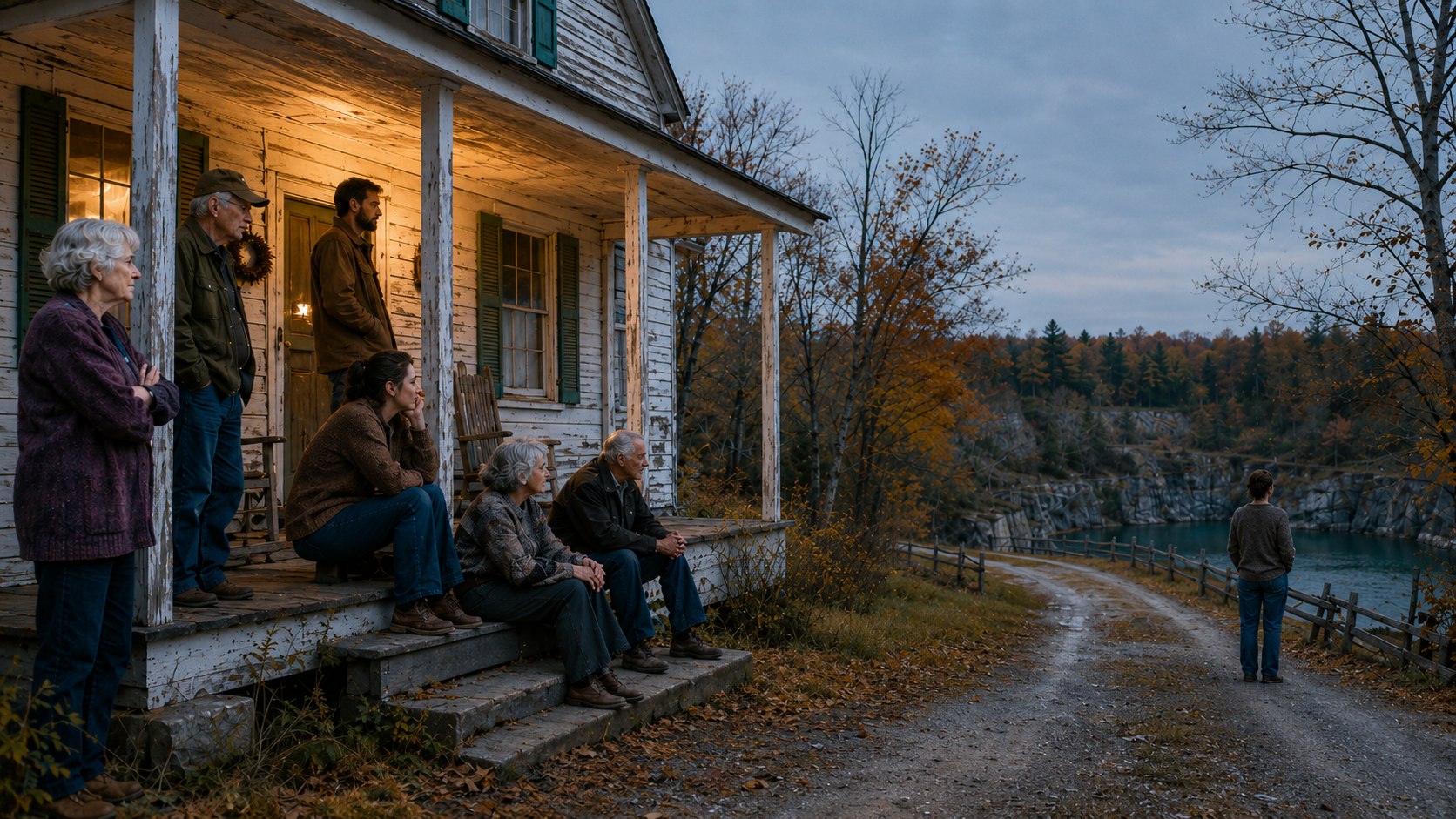
It was separate from the house. The house sat on its own town lot. This was the far piece, the strip up the gravel where the haul road bent toward the water, deeded to Stefania alone in a year Lila had to read twice to believe. Nineteen forty-nine. Her grandmother had owned that ground since the year after she came off the boat. A penniless refugee girl of eighteen had somehow come to own a parcel of Pennsylvania limestone within months of arriving, and had held it for seventy-seven years, and had never once, in all of Lila’s childhood, mentioned it.
She drove out to Cedar Run that afternoon with the envelope on the passenger seat.
Stefania was in the dayroom by the big window, a blanket over her knees, watching the parking lot as if it were the sea. She brightened at Lila, then frowned at the envelope before Lila had even spoken.
“You went in the breakfront,” she said.
“I’m sorting the house, Babcia. That’s the job.” Lila pulled a chair close. “I found the deed. The piece up the road. You said yesterday it doesn’t get sold.”
“It does not.”
“Okay. But the realtor’s going to ask why. People ask why. Is it, what, is somebody’s well on it, is there a right-of-way?” She kept her voice easy. “Help me understand it so I can tell them.”
For a while she thought her grandmother had drifted. The blue eyes stayed on the window. Then Stefania said, in the flat careful English she had built over a lifetime on top of another language, “Land remembers. You think it is only dirt. It is not only dirt.” She turned her head, and the clarity was there, fierce and brief. “Some ground you do not disturb. You leave it. You let it be quiet.”
“Quiet from what?”
The old woman’s hand came out and gripped Lila’s wrist, the same startling strength as the day before. “Promise me,” she said. “You and your mother. The piece by the road, you leave it alone. You do not let them dig there. Not for a house, not for the water company, not for anything.” Her voice dropped. “There is nothing there to find. You understand me? There is nothing there.”
It was the strangest thing, Lila would think later, the way a person could say there is nothing there and make you certain, down in your stomach, that there was everything there.
“Babcia,” she said carefully, “what’s up the road?”
But the grip had loosened, and the fish had slipped back under the ice. Stefania settled into the chair and looked at the parking lot, and when she spoke again her voice had gone soft and girlish and far away.
“Joseph would know,” she said. “Ask Joseph. He helped me.” She smiled at the glass, at something only she could see. “Such cold that winter. The ground was like iron.”
“Who’s Joseph?”
Her grandmother did not answer. A nurse came with the four o’clock pills, and the moment was gone, papered over with small talk and water in a paper cup, and Lila drove home in the dusk with the deed beside her and one word turning over and over in her mind.
Joseph. He helped me. Such cold that winter.
Helped her with what, in a winter seventy-seven years gone? And who in this emptied-out town was named Joseph and old enough to have been there?
The answer was waiting half a mile up her own road, and she did not know it yet.
The Reading Room — All Chapters
- Chapter 1/Episode 1: The Last House on Quarry RoadAfter Years Away, A Daughter Comes Home To Empty A House
- Chapter 1/Episode 2: The Piece That Does Not Get SoldA grandmother's strange rule about one strip of land.
- Chapter 1/Episode 3: The Man Half a Mile Up the RoadThe Neighbor Who Knew Her Grandmother Before The Family Did
- Chapter 1/Episode 4: Throw It Out, Don't LookWhy Does Her Mother Want These Boxes Thrown Out Unopened?
- Chapter 1/Episode 5: The Wardrobe With a Hollow BackShe Knocked On The Wardrobe And It Answered Wrong
Interesting
Hmmm a mystery.
Love the writing can’t wait till the next chapter!
I was immediately hooked. A great idea for folks like me who love to read.
Very interesting it holds your attention