They sat around Stefania’s bed at Cedar Run on a gray Thursday morning, because Cedar Run had a private family room they could borrow, and because the doctors had said, after Tuesday’s small episode, that her grandmother should not be moved more than was strictly needed in the coming days.
Stefania was awake. The blue eyes were clear. She had asked, when Lila came in early, to be propped up against the good pillow and to have her cardigan on, the one her own mother had crocheted for her in the camp in 1947, the only thing from that life she had brought across the water besides the box. Lila had not seen the cardigan in years. Her grandmother had asked the aide to find it that morning. There were things, Lila understood, you put on for a meeting like this.
Father Karol came in first, in his black sweater, with a manila folder under his arm. He had stayed with Father Bryla overnight. He was tired. He looked at Stefania and he smiled the small priest’s smile of a man who has spent the night holding a hundred-and-four-year-old hand and is glad to be standing in another room with the living.
“Pani Stefania. Anton sends his love. He is sleeping now. The nurse says he had a quiet night.”
“Thank you, Karolu.”
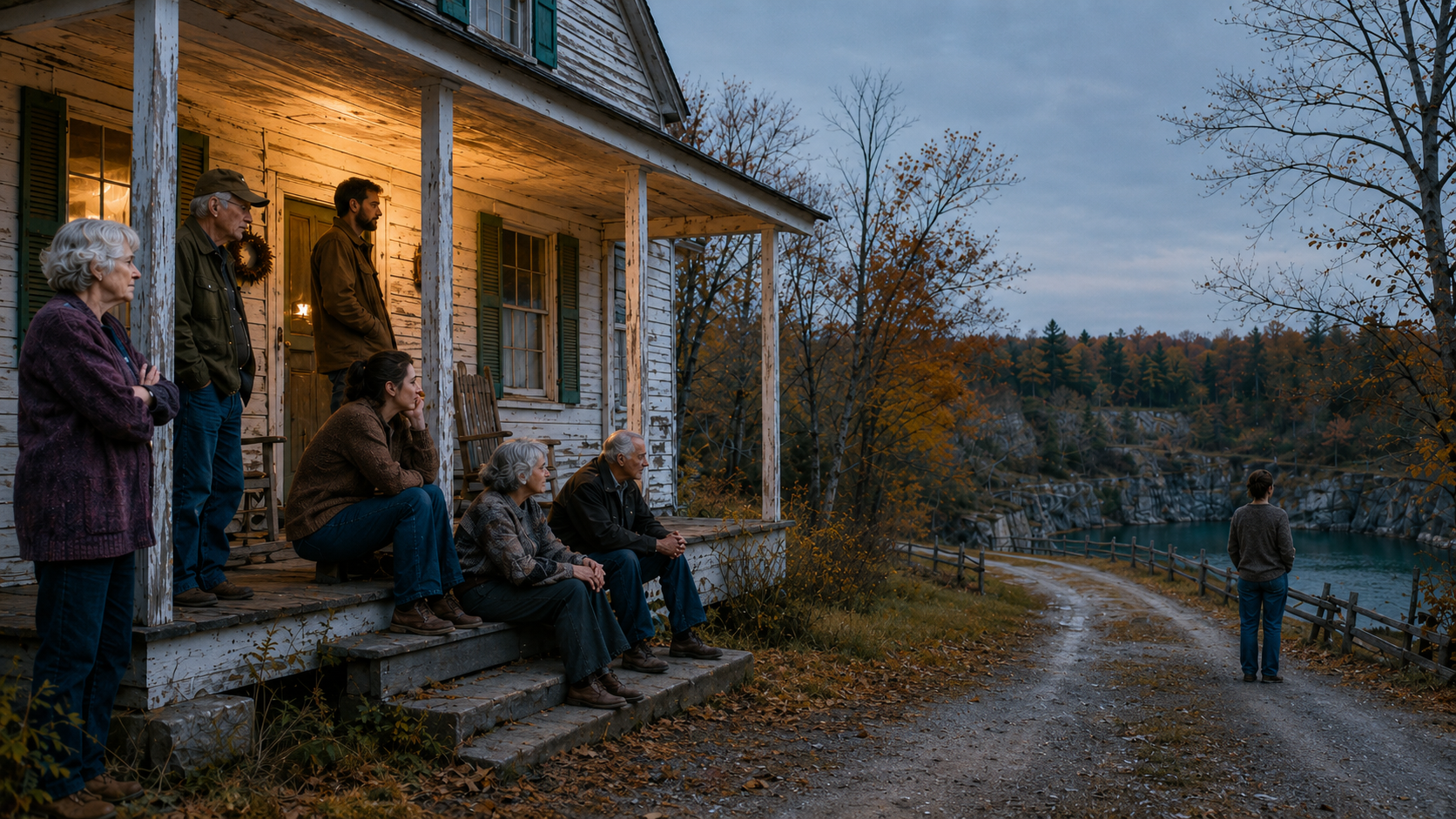
Rose came in next, with Joseph Mazur on her arm, because Joseph walked slowly now, and because something had happened on the porch on the way in that the two of them were not yet ready to talk about and that Lila, watching them through the window, had not been able to look away from. They had walked up the path side by side. Joseph had his cap in his hand. Rose had her hand under his elbow. They had stopped at the bottom of the steps and had stood a moment looking at each other, an old man at ninety-seven and a woman of sixty-eight, and Rose had said something Lila could not hear, and Joseph had nodded, and Rose had brushed something invisible off the shoulder of his coat with her free hand, the way a sister might, and they had come up the steps. Lila understood, watching them, that her mother had told Joseph Mazur, sometime between yesterday and now, that the figure he had seen at first light on the sixteenth of July, ‘seventy-three, had been her, and that Joseph Mazur had received the news the way Joseph Mazur received everything, which was with the cap in his hand and very little need to say.
Now they sat down. Joseph in the visitor’s chair. Rose on the foot of the bed beside her mother’s feet, in a way Lila had never seen her sit. Father Karol in the second chair. Lila stood, because there was no fourth chair, and standing felt right.
“All right,” Father Karol said gently. “We are five. We are all the people who need to be here.” He opened the folder. “Pani Stefania, I have the diocesan letter that Anton wrote and the bishop signed three weeks ago. I have a draft permit application for the county for the disinterment of a private burial on an owned parcel, which under Pennsylvania law is permitted with parish authorization. I have a phone call already in to the sheriff’s office, so they know what we are doing and we are not surprising anybody. And I have the offer of two men I trust to do the digging, Mr. Knapp the parish handyman, who has done graves at St. Hedwig’s cemetery for twenty-five years, and his nephew, who is a young man who can keep his mouth shut, which I have personally tested. They will work for the parish at no charge. They have not been told whose, and they will not be told until the morning of, and they will be told the smallest part of the truth that the work requires.”
He looked up.
“What I do not have, and what I am here for, is the day. And the family’s blessing on every part of it. We will not move a stone of that ground without the four of you saying yes.”
Stefania looked at the ceiling a moment. Then she looked at Joseph.
“Józef,” she said quietly. “It is your son’s keepsakes up there too. It is not only mine.”
“I know that now, Pani Stefaniu. Rose told me on the path.”
“Then I will not have him up out of the ground without your saying so.”
Joseph held his cap on his knee. He looked at the floor. He looked at her. “Stefania.” He used her name without the Pani for the first time in seventy-eight years, in this room, that any of them had ever heard him do, and Lila felt her mother’s hand twitch on the blanket. “Stefania. We have stood on the same stretch of ground for the better part of a century without putting a name to either of our griefs. I would like to put names to both of them before either of us goes. I would like my Peter’s things brought up too. I would like them to come back to me and to Rose. And I would like your Mikołaj to come down to St. Hedwig’s and have his Mass and his stone.” He paused. “Yes. I say yes. We open the ground.”
“Yes,” said Rose.
“Yes,” said Lila.
“Yes,” said Stefania.
Father Karol nodded slowly. “All right. Then we will do it the day after tomorrow, at dawn. Saturday morning. The weather is to be clear. The ground is not frozen yet. Mr. Knapp will be at the bend at six with hand tools and a tarp. I will be there with the holy water and the small ritual. Anton has asked, if he is still with us, to be brought to the parish hall after, so that he may hear how it went. If he is not still with us by Saturday, we will do it for him as much as for ourselves. Are we agreed.”
“Yes,” said all four of them.
The November light at the window was thin and gray. The radiator clinked. Somewhere down the hall a cart wheel squeaked by. Stefania was looking at Joseph and Joseph was looking at Stefania and neither of them was saying anything, the way old people who have loved each other across a lifetime of married others do not say anything in a room full of their children.
“There is one more thing,” Father Karol said. “I do not want to leave it unspoken. Pani Stefania. Whatever is in that box that you have not yet told these people, you will be asked, the morning we open it, to tell them what you wish them to know. The card. The letter. The photograph. The pieces that go to the boy’s name and his story. I am asking now, in the room, with all of you here, whether you would like me to read what is in the box aloud at the graveside on Saturday, or whether you would prefer to tell it yourself, in your own voice, in your own time, on the same morning.”
Stefania was quiet a long moment.
“I will tell it,” she said. “I have carried it alone for so long, Karolu. It is mine to say. I will tell it on Saturday morning at the bend in the road, in front of my daughter and my granddaughter and Józef and you, and we will set it down. The voice I have left is enough for that. I have been saving it.”
“Yes, Pani.”
“Then we are finished here, I think.”
“We are finished here.”
They sat in the small room a little longer, not because there was anything more to plan, but because none of them wanted to be the first to stand up. Outside, the November light went on getting thinner, and Saturday came toward them through the gray field.