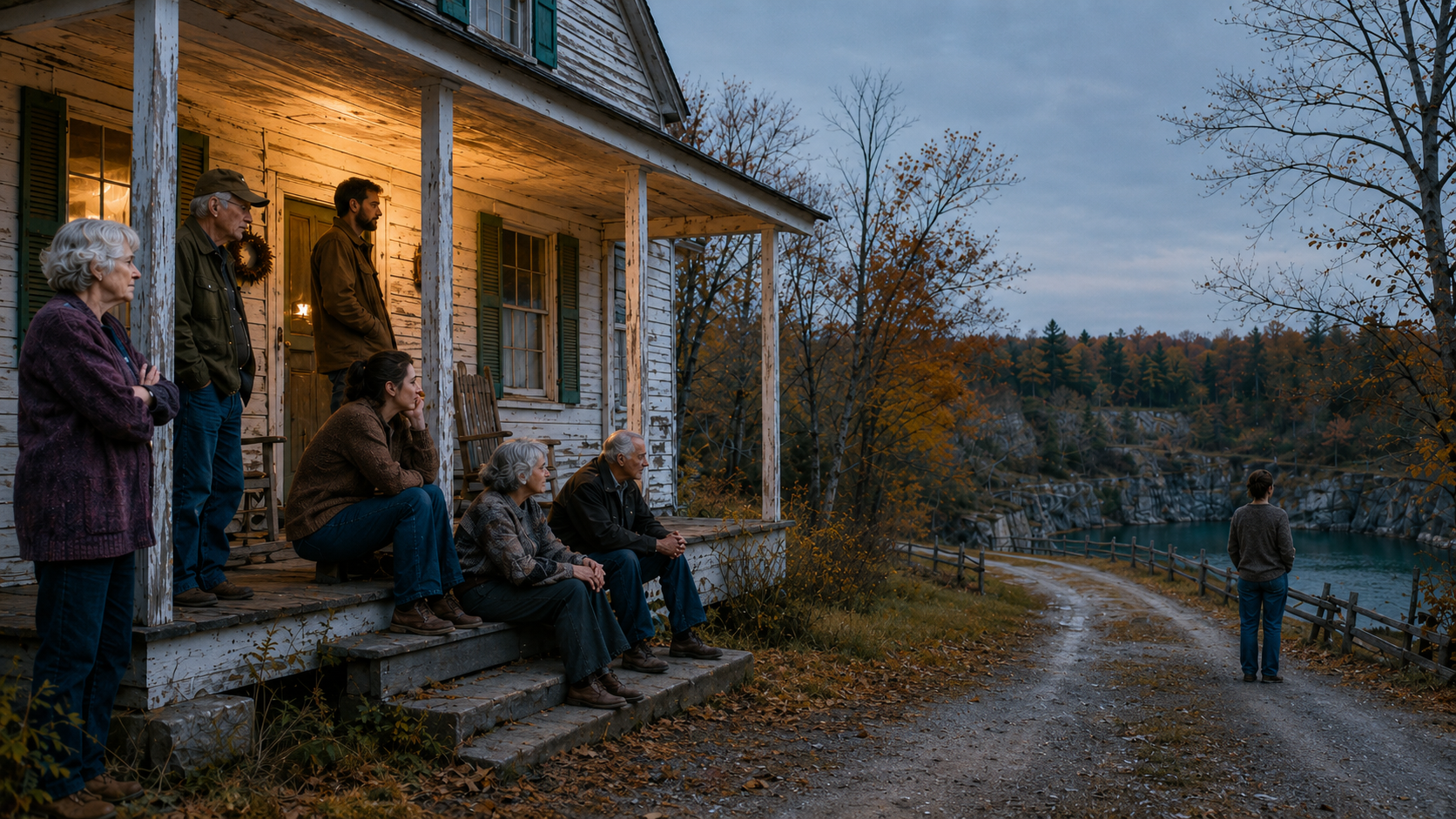
By December the house knows her. She knows the house. She knows which board on the porch creaks if you step on the left side of it, and which window will not seat all the way, and that the kitchen stove will draw better if you crack the door a quarter inch before you bank it, and she knows that Pani Bartos sings only when she is washing up, and only the same hymn, the Bogurodzica, the old one, the one the girls in the camp had sometimes sung after supper when nobody was being asked to feel anything.
It has been a good month. She has not let herself say it, even to herself, because saying a thing in the camp had often been a way of losing it, but it has been a good month. The widow is kind. The work is honest. Mikołaj has grown a little. He has begun to take a few wobbling steps along the davenport, holding the upholstery with both hands and looking back at her in absolute outrage when his small legs betray him. He has a sound he makes when he wants to be picked up, more a vibration than a word. She knows it. She picks him up.
On Sundays now she walks to Mass at St. Hedwig’s with Pani Bartos, and she takes Communion from Father Janowski, and after the Mass she stands in the narthex with the other women in their hats and lets them tell her, again, that they are praying for her, that they have a niece-in-law’s mother who came over in ‘forty-six and is still in Allentown if she would like a friend, that the country is hard but they are glad she has come. And after the Mass, every Sunday, Joseph Mazur is somehow at the back wall of the narthex, looking at the floor, and when she goes past him she says, dobre niedziele, panie Józef, and he says, in his bare uncertain Polish, dzień dobry, pani Stefaniu, and they do not look at each other for longer than the saying of it takes, and it is enough.
By the second Sunday in Advent the baby is hot.
She does not name it the first day. He is a little warm to the cheek, no more than that, and he goes down hard for his afternoon nap, and he wakes himself up crying, and he is hotter then, and she puts a cold cloth on his forehead and rocks him in the kitchen chair and tells herself that babies run hot. They do. He has run hot before. By the second day he will not nurse, and his lips are cracked, and the small heat of him under her hand is a heat she remembers from the camp infirmary, from the season when Marta took ill, and she sits in the kitchen and is afraid.
Pani Bartos is in town. The widow has gone to her sister’s in Allentown, on the train, for three days, the first time she has gone since Stefania came. She has left Stefania the run of the house and a piece of paper, on the icebox, with a telephone number for the sister and a telephone number for Father Bryla at the rectory and, beneath them, in the careful schoolroom hand she always uses for English, the words THE DOCTOR HAS A TELEPHONE TOO, BARNES, MAIN 4-2228.
Stefania looks at the paper from the kitchen chair with the hot baby across her chest, and she does not get up to go to the telephone.
She knows how. Pani Bartos has taught her, the way the widow has taught her everything, the operator, the asking for the number, the small American courtesies. The thought of the doctor, Mr. Barnes, the thought of a strange American man in a long coat coming into this kitchen and asking her, in English, who she is, who the baby is, where his father is, where his papers are, what his date of birth is, will the baby be all right, what is his name, his full name, ma’am, the thought of his full name said in the kitchen, the thought of any of it being entered onto any paper anywhere in this country.
She sits in the chair with the baby against her, and the snow comes harder on the iron porch roof outside, and the lamp burns yellow on the oilcloth, and she rocks. She knows what she should do. She is eighteen years old and she has carried this child across an ocean and she has, in three and a half years of war and aftermath, never once sat down with a thing she should have done and left it undone. She does not do this now either. She gets up. She walks to the wall. She lifts the receiver.
She listens. She puts it back down.
The operator’s voice has been a girl’s voice. Pleasant. American. Number, please.
She is afraid, she discovers, of the question that comes after the operator. She has not, in the whole month here, in any conversation with any woman of this town, in any moment after Mass, in any small daily thing, ever once given anyone the baby’s father’s name. She has said, very quietly, when it has been asked, that he is gone, that he is not coming. She has said this in Polish. Pani Bartos has not asked her past it. The women at St. Hedwig’s have not asked her past it. She has been a widow at eighteen for one solid month here, in this town, by a kind general silence, and she has not had to lie out loud about a single piece of paper.
If she calls the doctor, he will come, and he will be kind, and he will help her baby, and he will need to write the baby’s name on a piece of paper at the bottom of his bag.
The baby makes the small sound he makes that is the hurting sound, and she presses him to her shoulder and walks the kitchen floor.
She walks the kitchen floor a long time, in the lamp-yellow and the snow-sound, and she tries to remember how Marta had looked when the fever broke for her, the brief deceiving hour of it, before it came back, and Marta had said in her language that had been the same as Stefania’s, take him, take him as your own, do not leave him to the camp, do not leave him to the German nuns, take him and tell everyone he is your son.
Take him, Stefciu. Tell them he is yours. I will not haunt you.
She has not let herself think Marta’s name in a month.
By midnight the fever has gone past anything she has felt with her hand in three years, and the baby is breathing with a small clicking catch in his chest that frightens her in a place that is older than English and older than this country, and she sits down in the kitchen chair and holds him against her with his hot wet hair under her chin and she rocks and she rocks and she rocks, and outside the snow comes harder against the window glass, and from the wall the telephone hangs silent.