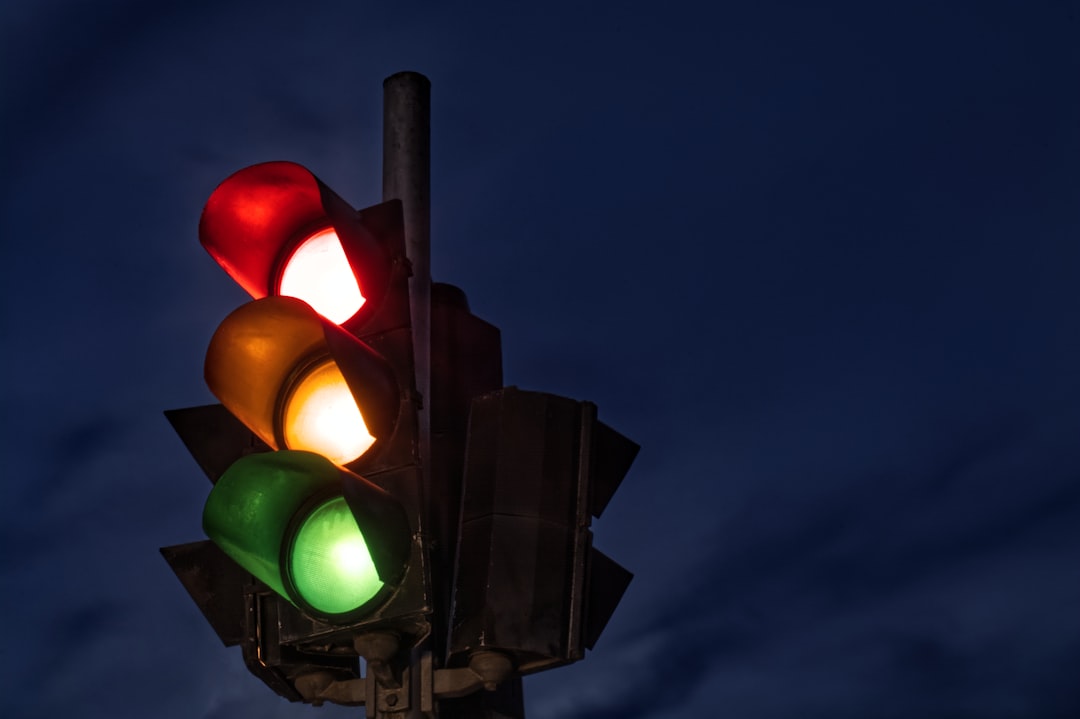
Red means stop. Yellow means slow down. Green means go. Most of us learned that before we ever sat behind the wheel. So when you spot a bright blue light mounted near a traffic signal, it is natural to wonder what on earth it is supposed to mean.
Here is the short answer: it does not mean anything to you. That blue light is there for the police, not for drivers.
What the Blue Light Actually Does
The blue light (sometimes called a confirmation light or red-signal indicator) is electrically linked to the red light at the intersection. When the red light turns on, the blue light turns on at the same moment.
That lets an officer positioned at a different angle, or with a partially blocked view, say, from a tree branch, confirm that the signal was red when a driver rolled through it. Without the blue light, officers often had to stand on the same side of the intersection as the driver just to see what the signal was showing.
David A. Noyce, a transportation engineering professor at the University of Wisconsin–Madison, explained it to Reader’s Digest this way: officers use the blue light to observe the red signal when they cannot see it directly. It lets them physically witness a red-light violation from nearly anywhere at the intersection.
Why Does That Matter?
In many states, a police officer must personally witness a traffic violation before issuing a citation. The blue confirmation light makes that possible without the officer having to dart across a busy intersection, which, according to a Federal Highway Administration report, is exactly the kind of dangerous situation these lights help prevent.
Better enforcement also has real safety benefits for everyone on the road. The Insurance Institute for Highway Safety reports that more than 141,000 people were injured in red-light-running crashes in 2024, and 1,119 were killed. About half of those fatalities were pedestrians, bicyclists, or passengers in other vehicles hit by drivers who ran the red.
A Minnesota study of Florida’s confirmation-light program, launched in 2014, found that crashes caused by red-light runners dropped by 33 percent at intersections where the lights were installed.
Why Blue?
The Federal Highway Administration’s guidelines say these lights should not be red, yellow, or green because those colors already have meaning for drivers. Blue was chosen partly because it is not part of the standard traffic signal system, so drivers are far less likely to confuse it with an instruction to stop, slow down, or go.
Professor Noyce also notes that blue LEDs stand out clearly at night. Most other roadway lights (headlights, streetlights, signs) fall in the white, yellow, amber, and red range. Blue cuts through that background and catches the eye. Its strong association with law enforcement does not hurt either.
Where Are These Lights Showing Up?
There is no national database tracking them, and they are not part of the federal standard traffic signal system. Adoption is scattered. Local police departments and transportation agencies decide on their own whether to install them.
According to Noyce, blue confirmation lights are most common in Florida and Colorado, though they have appeared in other states as well. One early example dates to 2007 in Marysville, Washington. They tend to get installed one intersection at a time, which is why most drivers have never heard of them until they spot one and start wondering.
So What Should You Do If You See One?
Exactly what you have always done. Follow the traffic signals: red, yellow, green, and drive normally. The blue light carries no instruction for you.
As Noyce puts it, the lights mean nothing from a rules-of-the-road standpoint for drivers, bicyclists, or pedestrians. That said, knowing one is there might just be a good reminder that someone could be watching. And honestly, that is the whole idea.