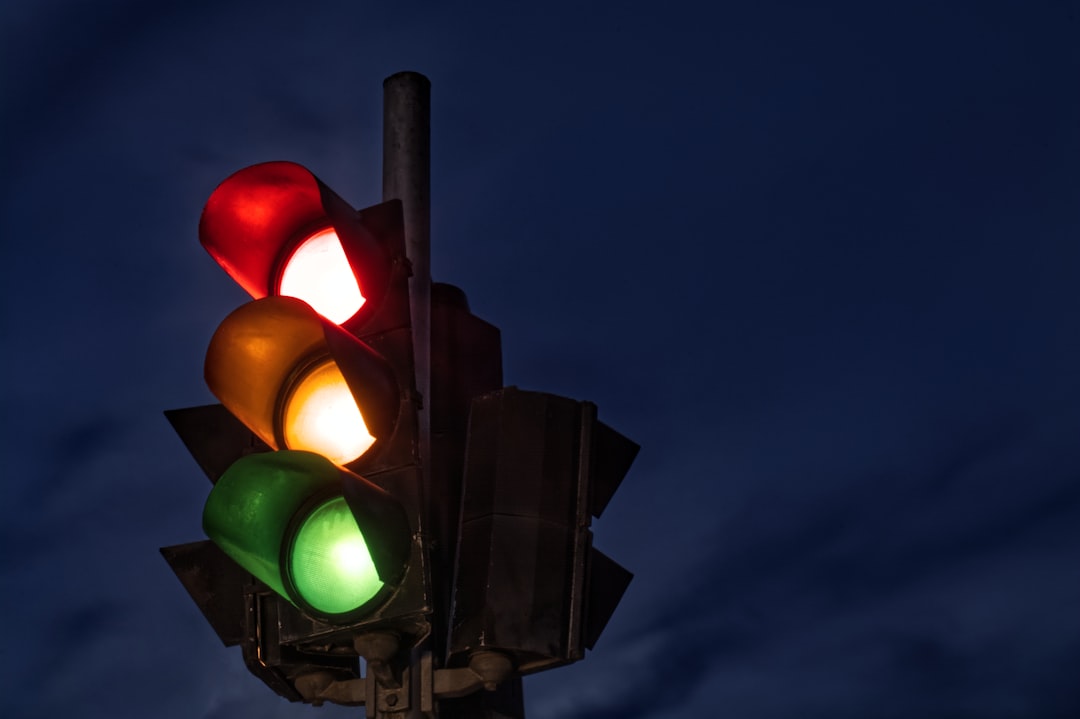
Red means stop. Yellow means slow down. Green means go. Most of us learned that before we ever sat behind the wheel. So when you spot a bright blue light mounted near a traffic signal, it is natural to wonder what on earth it is supposed to mean.
Here is the short answer: it does not mean anything to you. That blue light is there for the police. Drivers, walkers, and cyclists can carry on exactly as before.
This week’s article on this topic was our most-read story of the week, and it left a few natural follow-up questions on the table. Is it a camera? Can it get you a ticket? Why blue, of all colors? And where exactly are these things showing up? Those questions deserve a fuller answer, so here it is.
What the Blue Light Actually Does
The blue light (sometimes called a confirmation light or red-signal indicator) is electrically linked to the red light at the intersection. When the red light turns on, the blue light turns on at the same moment. When the red goes off, so does the blue.
That is the whole mechanism. There is no timer, no sensor, no computer deciding anything. A wire runs from the signal controller to a small blue lamp, and the lamp follows the red light like a shadow.
The lamp itself is usually mounted on top of the signal head, though some towns put it on the side, on the overhead mast arm, or on the back of the signal so it faces away from approaching drivers. In Everett, Washington, the blue dot shines from the backside of the signal head. In Ramsey County, Minnesota, the county placed them on the corner poles instead, where each one lights up whenever the opposite signal turns red.
Traffic engineers have given these lights some colorful nicknames over the years. A Federal Highway Administration report lists “enforcement lights,” “rat lights,” “rat boxes,” and “tattletale lights.” In Washington State, they go by “telltale lights.” Every one of those names points to the same job. The light tells on drivers who run the red.
Is It a Camera? No.
This is the first question most people ask, and it deserves a plain answer. The blue light is a light bulb. It takes no pictures, records no video, and mails no tickets.
Red-light cameras are a different system entirely. A camera is wired to the signal and to sensors near the stop line, and it photographs any vehicle that crosses after the light turns red. A person reviews the photo, and a ticket arrives in the mail. In most states, those camera tickets are treated as civil offenses, similar to a parking ticket, with no points on your license and no effect on your insurance. A few states, including Arizona, California, and Oregon, treat camera citations the same as tickets written by an officer.
A blue confirmation light works the old-fashioned way. An officer has to be physically present, has to see the violation, and has to pull the driver over. A ticket written that way is a regular moving violation, with everything that comes with it.
There is one more difference worth knowing. The Federal Highway Administration notes that confirmation lights cost far less to install and maintain than camera systems, and they sidestep the controversy that has followed automated photography in many communities. That may explain some of their appeal in places that never warmed to cameras.
Why Does That Matter?
In many states, a police officer must personally witness a traffic violation before issuing a citation. That sounds simple until you picture the geometry of a busy intersection.
Without a confirmation light, an officer who wants to catch a red-light runner heading east has to be sitting somewhere he can see the eastbound signal. That usually means the same side of the intersection as the driver. When the driver blows through, the officer has to cross the intersection against that same red light to give chase. For years, the alternative was to station two officers: one upstream watching the signal, one downstream waiting to make the stop.
The blue light changes all of that. David A. Noyce, a transportation engineering professor at the University of Wisconsin-Madison, explained it to Reader’s Digest this way: officers use the blue light to observe the red signal when they cannot see it directly. It lets them physically witness a red-light violation from nearly anywhere at the intersection. One officer, parked safely on the far side, can see the blue dot, see the car roll through, and make the stop without ever crossing against traffic.
Florida figured this out early. Hillsborough County, home to Tampa, began installing white enforcement lights back in 2002. Police there reported that the lights cut the manpower needed for red-light enforcement in half, and the number of red-light citations written each year rose from about 17,500 to about 24,500 after the lights went in.
The Safety Numbers, Plainly
Better enforcement also has real safety benefits for everyone on the road. The Insurance Institute for Highway Safety reports that more than 141,000 people were injured in red-light-running crashes in 2024, and 1,119 were killed. About half of those fatalities were pedestrians, bicyclists, or passengers in other vehicles hit by drivers who ran the red.
Those numbers land differently once you realize how common the offense is. In a 2024 AAA survey, 80 percent of drivers said going through a light that had just turned red was very or extremely dangerous. In the same survey, 27 percent admitted they had done it within the past 30 days.
So what happens when the blue lights go up? The most careful study to date comes from the Federal Highway Administration, which looked at four-way signalized intersections in Florida before and after the lights were installed. Crashes caused by drivers disobeying the signal fell by about 29 percent. Left-turn crashes fell by 40 percent. Crashes involving injury or death fell by 14 percent.
Just as important is what did not happen. Rear-end crashes, which sometimes rise when camera enforcement arrives, showed no meaningful change with the blue lights.
The lights also earned their keep. Weighing the cost of installation against the cost of crashes avoided, the researchers estimated that every dollar spent returned about 92 dollars in benefits. Ramsey County, Minnesota, gives a sense of the price tag. A $120,000 federal grant plus $13,000 in local money paid for 128 blue lights at 49 intersections in 2014, which works out to roughly a thousand dollars per light.
The county chose those intersections because its safety review kept turning up right-angle crashes from drivers running reds, and right-angle crashes tend to produce the worst injuries. A county planner there passed along what local police had told him: they had no interest in writing more tickets. They just wanted people to quit running red lights.
Why Blue?
The Federal Highway Administration’s guidelines say these lights should not be red, yellow, or green because those colors already have meaning for drivers. Blue was chosen partly because it is not part of the standard traffic signal system, so drivers are far less likely to confuse it with an instruction to stop, slow down, or go.
Blue came later, though. The earliest versions, including those Hillsborough County lights, were white or clear. Gainesville, Florida, used white lights before switching to blue LEDs. When the Federal Highway Administration compared the two, it found no difference in how well they reduced crashes, so the switch to blue came down to practicality.
Professor Noyce also notes that blue LEDs stand out clearly at night. Most other roadway lights (headlights, streetlights, signs) fall in the white, yellow, amber, and red range. Blue cuts through that background and catches the eye. A white confirmation light can get lost among all the other white lights at a busy corner. A blue one cannot, and it is far less likely to be mistaken for a turn arrow or a pedestrian signal. Its strong association with law enforcement does not hurt either.
Where Are These Lights Showing Up?
There is no national database tracking them, and they are not part of the federal standard traffic signal system. Adoption is scattered. Local police departments and transportation agencies decide on their own whether to install them, and they usually pick intersections with a known red-light-running problem rather than blanketing a whole town.
According to Noyce, blue confirmation lights are most common in Florida and Colorado. In Florida they have turned up in Gainesville, Orlando, Fort Myers, and Collier County, among other places. Anyone who spends winters in Florida has very likely driven under one without knowing it.
They have spread well beyond the Sunbelt. Minnesota has installed them in Ramsey County, Maplewood, Blaine, Crystal, and elsewhere. Prairie Village, Kansas, added them around 2017 at crash-prone intersections. Bismarck, North Dakota, outfitted most of its intersections in 2018. In Washington State, Marysville was using them as far back as 2007, and Everett has them downtown. Drivers in the Hampton Roads area of Virginia have been asking about them online, too.
Because they go in one intersection at a time, and because the local news coverage tends to be sporadic, the first encounter usually comes as a surprise. Some communities, Ramsey County among them, put up temporary signs when the lights first arrive. Plenty of drivers still find out the way you probably did: by looking up at a red light and wondering.
A Few Things Worth Knowing at Any Intersection
The blue light will not change how you drive, but the questions it raises are a good excuse to review a few rules that trip up even careful drivers.
Getting caught in the intersection is different from running the light. If you pulled into the intersection on green to make a left turn, waited for a gap, and the light turned red while you were sitting there, you have done nothing wrong. Finish the turn when it is safe. The violation happens when a vehicle enters the intersection after the light has already turned red.
Right on red still means stop first. A rolling right turn at a red light counts as red-light running in the eyes of the law. Come to a full stop, look, and then go. Where a sign prohibits turning on red, wait it out.
Yellow is a decision. The Insurance Institute for Highway Safety points out that intersections with adequate yellow time see fewer red-light violations and fewer crashes. That part is up to the traffic engineers. The part that is up to you is to decide once and commit. If you can stop comfortably, stop. If you are too close to stop safely, continue through at a steady speed. Slamming the brakes at the last second and speeding up to beat the red are the two moves that cause the most trouble.
A blue light does not mean an officer is there. The lights are on all day, every day, whether anyone is watching or not. Ramsey County put them at intersections that are hard for police to enforce as well as easy ones, in the hope that drivers would behave at all of them.
So What Should You Do If You See One?
Exactly what you have always done. Follow the traffic signals: red, yellow, green, and drive normally. The blue light carries no instruction for you.
As Noyce puts it, the lights mean nothing from a rules-of-the-road standpoint for drivers, bicyclists, or pedestrians. That said, knowing one is there might just be a good reminder that someone could be watching. And honestly, that is the whole idea.