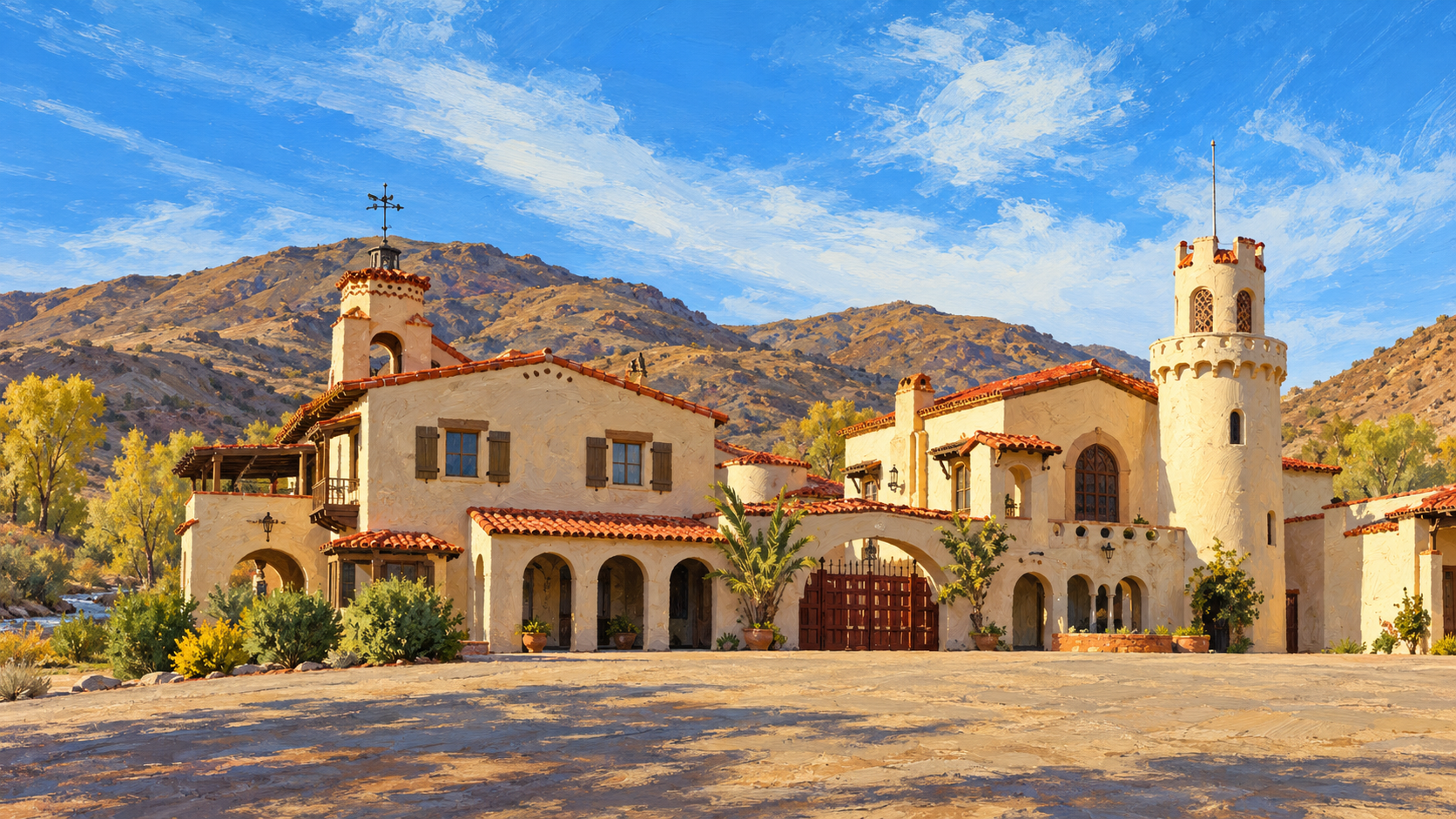
If you ever drove to the far north end of Death Valley, you may remember what waited there. A Spanish villa with a red tile roof and a clock tower, in a desert canyon with its own spring. It had no business being there.
You are in good company. When Scotty’s Castle was open, it drew 100,000 visitors a year. Guides in period costume walked them through rooms filled with the original furniture.
Then, in October 2015, a flash flood closed it, and it has stayed closed. This month, the National Park Service announced that the grounds are open for tours again, most weekends through April, and it has named the earliest date for a full reopening.
What Closed the Castle?
The park tells the story on its flood page. On the night of October 18, 2015, the castle received two and three-quarter inches of rain within five hours, a year’s worth. Rain and hail poured off the slopes of Grapevine Canyon as a flood of mud and rock. One ranger watched power poles and metal dumpsters float out of the canyon.
The water broke through the windows, doors, and walls of the garage that served as the visitor center and left four feet of mud inside. It took out more than 20 power poles, the water system, and most of the eight-mile road in. More than a mile of the concrete fence posts that Albert Johnson had stamped with a “J” and an “S” went with it.
The repairs ran into everything that can slow a job: funding, staffing, contracting, the pandemic, more floods, and a fire. In April 2021, with the garage repair 60 percent finished, the building burned to the ground.
Here is the part worth knowing: the new flood walls work. The park finished a large berm of earth and rock-filled baskets above the historic district in January 2023. When the remnants of Hurricane Hilary hit Death Valley that August, the castle came through without damage.
Who Was Scotty, and Why a Castle?
Walter Scott was born in Kentucky in 1872 and raised on a horse farm. He spent twelve years as a rider with the Buffalo Bill Wild West Show. When he left in 1902, he found a new line of work: convincing wealthy men that he had a claim to a gold mine in Death Valley.
His last investor was Albert Johnson, a Chicago insurance man who gave Scott thousands of dollars and finally came to see the mine. Scott took him on a grueling horseback trek. He figured a few days in the desert would be too much for a city man whose health had been damaged by a train accident in his youth. Johnson stayed nearly a month; his health improved in the dry air, and the two became friends for life.
He never saw the mine. The park’s own history page says Johnson was most certainly being swindled and did not seem to mind. He had, as the page puts it, “found riches in the desert far greater than those that glitter.”
In the 1920s, Johnson and his wife, Bessie, built their winter retreat in Grapevine Canyon and called it Death Valley Ranch. Scott told visitors he had built it himself, on top of his mine. Abby Wines, the park’s acting deputy superintendent, told the Associated Press in January that in its heyday the castle was “the stage for a massive practical joke on all of America.” Scott lived there until his death in 1954 and is buried on the hill above it.
What You Can See This Winter
The castle itself is still closed. Its 139,000 archives, furnishings, and artifacts, from the furniture to woven Timbisha Shoshone baskets, sit in storage away from the park until construction is done. But the grounds are open again.
On October 8, the park announced guided walking tours of the grounds most Saturdays and Sundays from October 10 through April 17. Rangers and guides from the Death Valley Natural History Association lead them, and small groups can request private weekday tours. Visitors walk the historic district and see the repair work in progress. Tickets go through the association, and reservations are required.
The next round of construction is expected to start in 2027: the parking lot, the historic Longshed, and the old Gas Tank House, which will become a small visitor station. After that, the furnishings come home and interior tours can resume. The earliest date the park will put on a full reopening is November 2028. From then on, the plan is to open the castle each year from late fall through early spring.
That is a long way off. But the road in stays closed to the public until then, and the grounds are open most weekends through April 17. The furniture goes back when the construction is done. You can go back sooner.