 You already know the feeling. A grandchild runs toward you, arms wide open, and everything else falls away. What you may not know is that this connection could be doing something remarkable for your brain.
A growing body of research curated by The Age suggests that being an active grandparent may help slow cognitive decline, lower dementia risk, and even leave your brain looking younger than your years.
What the Research Shows
In one of the first large population studies on American grandparents and dementia, researchers tracked more than 10,000 grandparents over 16 years. Those who cared for grandchildren had a lower risk of developing dementia, according to Seung-won Emily Choi, an associate professor of sociology at Texas Tech University who conducted the study.
A separate study published in 2025 looked at more than 10,000 older adults in China. It found that caregiving for less than 40 hours a week was linked to a 24 percent reduced risk of dementia compared with grandparents who were not providing care. The researchers suggested that reduced loneliness and greater use of digital technology may have played a role.
The act of caregiving itself appears to matter, too. A 2026 study by Flavia Chereches, a graduate student of developmental psychology at Tilburg University in the Netherlands, found that grandparents who cared for grandchildren had higher verbal fluency and better episodic memory than those who were not involved in caregiving.
Does It Matter If You Are a Grandmother or Grandfather?
Interestingly, research suggests the benefits may work a little differently depending on whether you are a grandma or a grandpa.
In Choi’s study, grandmothers gained the most from lower-intensity caregiving, fewer than 500 hours over two years. Grandfathers, on the other hand, tended to benefit more from higher-intensity involvement, more than 500 hours. And in Chereches’s research, only caregiving grandmothers showed less cognitive decline.
Some researchers connect this to the “grandmother hypothesis,” which looks at the evolutionary reasons adult female humans live long past their reproductive years, a trait shared by only a few other mammals, including some whales and chimpanzees. Evidence suggests grandmothers have a consistently positive impact on their grandchildren’s health, says James Rilling, a professor of psychology at Emory University.
Still, Chereches notes that what may matter most is not whether you are a grandmother or grandfather, but how you personally experience the caregiving role.
Why Grandkids Are Good for Your Brain
Healthy aging tends to involve three things: staying socially connected, keeping physically active, and giving your mind a real workout. Spending time with grandchildren can deliver all three at once.
Think about what a typical afternoon with a grandchild actually involves: reading aloud, playing make-believe, telling family stories. That is genuine mental stimulation. And while grandparents report more moments of sadness or worry when with grandchildren, perhaps due to concern for the children or bittersweet feelings about time passing, they also report more feelings of pride and love, according to Chereches and her colleagues in a 2026 study.
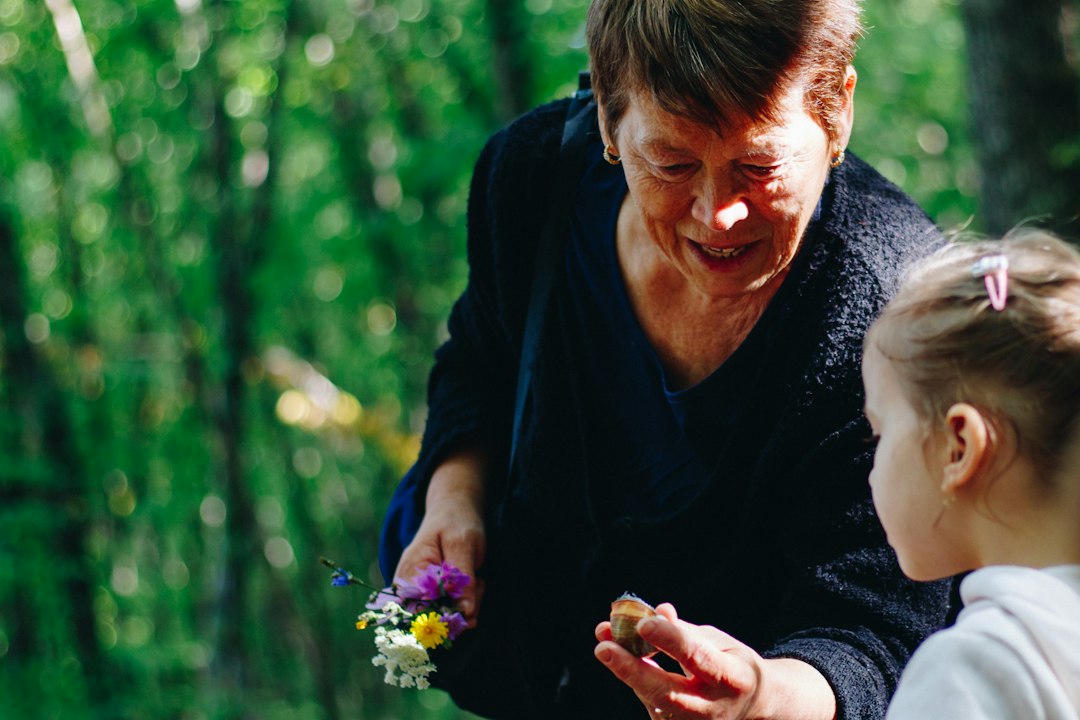
Time with grandchildren also tends to draw grandparents into a wider social circle. As Choi explains, those interactions often bring more contact with adult children, other family members, and the broader community.
And you do not have to be a biological grandparent to benefit. Research on older adults who volunteered with Experience Corps (an AARP program that places volunteers in elementary schools) found improved memory and executive function, along with decreased brain volume loss in areas associated with dementia.
A Brain That Looks Younger
In a 2025 study, Rilling and his colleagues scanned the brains of 50 grandmothers and compared them with 25 women of similar ages who were not grandparents. On average, the grandmothers’ brains looked five and a half years younger, based on estimates calculated by a computer model.
Rilling acknowledges these were particularly engaged grandmothers, physically and mentally healthy, financially stable, and deeply involved with their grandchildren. The studies are also associational, meaning they show a link but cannot prove that grandparenting directly causes the brain benefits. It is possible that healthier people are simply more likely to take on active caregiving roles.
Balance Is the Key
None of this means you need to become a full-time caregiver to protect your brain. In fact, the research points the other way. Grandparents who are the sole caretakers of their grandchildren are less likely to experience the cognitive benefits, according to the research. Caregiving can be physically and mentally exhausting, and too much can cancel out the gains.
Chereches puts it plainly: grandchild care is not the right fit for everyone. If it is something you want and it feels meaningful to you, it is a wonderful way to stay active and engaged. But there is no obligation and no one-size-fits-all answer.
Choi recommends keeping up with the basics that support your own well-being: good sleep, a healthy diet, regular exercise, and other social connections. Layer in the joy of time with grandchildren, and you may be doing your brain a quiet, lasting favor.