
After Years Away, A Daughter Comes Home To Empty A House
The town came up out of the river haze the way it always had, a church spire first, then the long gray ghost of the cement plant that had not run a kiln since before Lila was born. She slowed the rental car at the bend where Route 248 dropped toward the creek. Below, the water slid over the limestone ledge that gave Sandstone Falls its name, brown and unhurried in the late October light. She had forgotten the sound of it. She had spent twenty years forgetting a great many things about this place, and the river had been one of them.
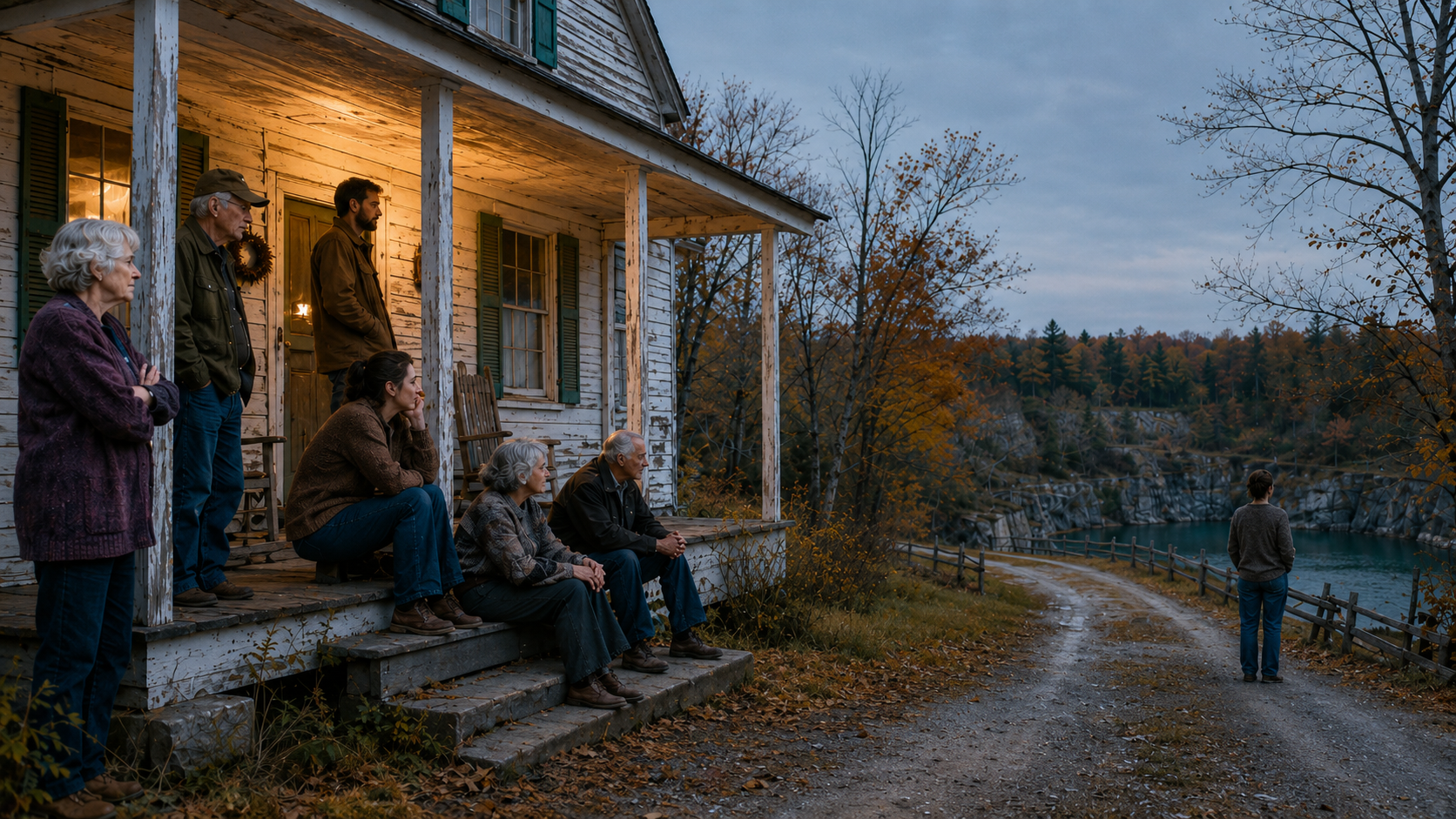
Quarry Road ran north from the square, past the shuttered Rexall and the VFW and the polka hall with plywood in its windows, then out where the houses thinned and the fields took over. The Wojcik house stood at the very end of the line, last before the road turned to gravel and climbed toward the old workings. White clapboard, green shutters, a porch that sagged on the east side the way it had sagged for thirty years. Her grandmother’s house. Soon to be nobody’s.
Rose was waiting on the porch with her coat already buttoned, as if she had been timing the drive. At sixty-eight her mother kept herself like a woman half her age, hair set, lipstick on at ten in the morning, hands folded against the cold.
“You made good time,” Rose said. It came out the way her mother said most things, flat and finished, a door closing gently.
“Traffic was light.” Lila came up the steps. They did the half-hug they always did, two women leaning toward each other from the shoulders up. “How is she today?”
“She’s herself. Mostly.” Rose looked past her at the car. “You only brought the one bag. You said two weeks.”
“Two weeks is plenty for a house this size, Mom.”
Rose’s mouth did something that was meant to be a smile. “You haven’t been inside yet.”
The inside smelled of her childhood, of dill and floor wax and the particular mustiness of a house heated by an oil furnace for seventy years. The front room was a museum of a certain kind of life. Crocheted afghans folded over the arms of the davenport. A console television the size of a steamer trunk, dead since the nineties, a doily and a dish of butterscotch candies on top. On the wall above it, a holy card of the Black Madonna in a dime-store frame, and beside it a photograph of her grandfather Henryk in his good suit, gone now twenty years.
And in the kitchen, in the wheelchair they had finally talked her into, sat Stefania.
Ninety-six years had folded her grandmother small. Her hands lay in her lap like two pale leaves. But her eyes, when they came up and found Lila, were the same hard pretty blue they had always been, and for a moment they were entirely clear.
“Lila.” She said it the old way, with the long European vowel. Lee-la. “You drove all this way.”
“Hi, Babcia.” Lila knelt by the chair and took the leaf-light hands. “I came to help.”
Something crossed the blue eyes then, quick as a fish under ice. “To help with what.”
“With the house, Babcia. Remember? You’re going to your new place. We talked about it.”
The clarity flickered. Stefania looked at the window over the sink, the one that faced north up the gravel rise toward the workings, and her face changed the way weather changes a field. “Who is up there,” she said. “Somebody is up there on the road.”
Lila glanced out. The gravel climbed empty into the trees. A crow lifted off a fencepost and that was all. “There’s nobody, Babcia. It’s just the wind.”
“You don’t see him.” It was not a question. Her grandmother’s hand tightened in hers with a strength that startled her. “Tell your mother. The far piece does not get sold. The piece up the road. You tell her.”
In the doorway behind them Rose had gone very still. Lila felt it more than saw it, a stiffening in the air of the room.
“Nobody’s selling anything yet,” Lila said gently. “We’re just starting.”
But Stefania had already drifted off, somewhere the rest of them could not follow, her lips moving over a word Lila could not catch. It might have been Polish. It might have been a name.
That night, after Rose had gone home to her own house in town and the dishes were done, Lila sat alone in the front room with a glass of her grandfather’s apricot brandy she had found in the sideboard. The house ticked and settled around her. Two weeks, she told herself. Sort, box, label, sell. A clean job. The kind of finite, manageable thing she needed after the year she had had, the divorce papers signed in spring, the apartment given up, the contracts that had dried up one after another until she was, at thirty-eight, a woman who restored other people’s photographs for a living and owned almost nothing of her own.
She carried the glass to the north window before bed. Force of habit, maybe, or her grandmother’s words still working in her. The gravel road ran pale under a half moon, up past the fence line and into the dark wall of trees where the quarry waited, that deep green water the whole town had warned its children away from for a hundred years.
There was nobody up there. Of course there was nobody.
But the kitchen light, when she reached to switch it off, showed her something she had walked past three times that day without seeing. On the sill of the north window, in the dust that had gathered untouched for who knew how long, was a clean half-moon swipe. As if a hand rested there often. As if someone stood at this exact glass, day after day, looking up the road, and wiped the dust away with the heel of one palm.
Her grandmother could not have. Stefania had not stood at a window unaided in two years.
Lila looked at the mark a long time. Then she looked up the dark road, and the cold came off the glass against her face, and for no reason she could have named, the hair rose on her arms.
The Reading Room — All Chapters
- Chapter 1/Episode 1: The Last House on Quarry RoadAfter Years Away, A Daughter Comes Home To Empty A House