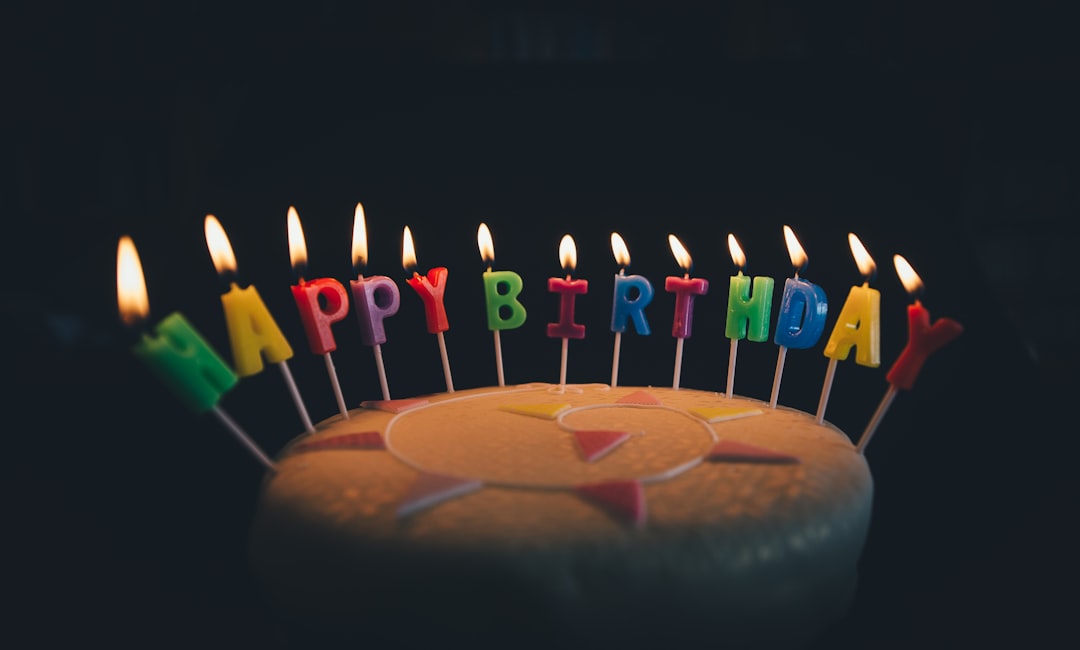
Think about how many birthday cakes you have stood over in your lifetime. The candles lit, everyone gathered around, and then that one quiet moment before you blow. You have done it dozens of times, maybe hundreds. But have you ever stopped to wonder why?
It turns out the answer stretches back centuries. And it involves ancient gods, German children, a Swiss folklore journal, and yes: Disney.
It Did Not Start With Candles at All
Candles did not appear on birthday cakes until the mid-1700s. That might surprise you, given how ancient candles themselves are. People have been lighting wicks for religious and practical reasons for thousands of years. They just were not putting them in frosting.
Before cake and candles became the standard, birthday celebrations looked more like religious observances than parties. The Romans threw genuine birthday festivities for the elite, but the real point was an offering to a person’s genius, a protective spirit believed to accompany someone throughout their whole life.
Early Christians moved even further away from birthdays entirely. Church figures wrote against celebrating them as too self-focused and too pagan. The Christian calendar centered instead on baptisms, Easter, and the deaths of martyrs, which were seen as a birth into heaven. Candles stayed in use for religious ceremony. Cake was not part of the picture for a long time.
How Germany Changed Everything
Cake came back as a festive food in the late medieval period, mostly in wealthy homes. Then, in the 1600s, Protestant regions began shifting away from saints’ feast days and toward personal milestones: birthdays, baptisms, weddings. That shift set the stage for what came next.
In 1691, a German scholar named Johann Christoph Wagenseil documented children’s birthday cakes in his writings about the city of Nuremberg. No candles yet. But it is the earliest known written reference to an actual birthday cake.
The candles arrived somewhere between 1691 and 1740, through a German children’s festival called Kinderfest. Pop culture historian Marie Nicola, who researches the history of human social rituals including birthdays, describes it this way: the cake was already celebratory, the candle already meant life, and the child already represented potential. The three things quietly came together.
Kinderfest had roots in Pietism, a Protestant movement that treated the home as a kind of moral training ground. Candles came to represent a child’s inner growth, with one lit for every year of life plus an extra one, the familiar “one to grow on.”
The writer Johann Wolfgang von Goethe described a birthday cake from a celebration in the 1740s surrounded by lights “like an altar.” That image tells you how sacred this little domestic ritual still felt, even after it had drifted away from formal religious ceremony.
The Wish Comes From Your Breath
By 1881, the tradition had traveled to Switzerland, where researchers writing for the Folk-lore Journal documented the full candles-on-a-cake ritual among the Swiss middle class, candles blown out before the cake was eaten.
Historian Kwasi Konadu, PhD, the John D. and Catherine T. MacArthur Endowed Chair and Professor at Colgate University, explains it this way: “The earliest written record of the ‘make a wish and blow out the candles’ ritual only appears in the late 19th century, describing a Swiss tradition, which likely borrowed from a German tradition of burning said candles all day for the birthday child’s spiritual protection.”
As for why a wish gets attached to a breath, that goes back even further. Across many belief systems, a person’s breath has long been treated as tied to their life force or soul. Nicola puts it this way: “Blowing out a candle while making a silent intention carries echoes of votive prayer. Only here, it’s domestic, child-centered, and delightfully secular.”
In other words, when you close your eyes and make your wish, you are performing something that resembles a quiet, private prayer. Just with frosting nearby.
How It Spread Around the World
German immigrants brought Kinderfest to the United States in the 19th century. German-language newspapers in cities like Philadelphia and Milwaukee published Kinderfest announcements throughout the 1800s. Historians can trace the custom’s slow crossover into mainstream American life through those very pages.
By 1900 to 1920, candles on cakes were a solid middle-class norm in both the U.S. and the U.K. By the 1920s, the ritual had gone fully commercial. Candles were mass-produced and sold in age-appropriate sets with their own little holders, available at big department stores.
Then came the moment that arguably locked the tradition in place. In 1931, Disney released a short film built around a birthday party. It became the template millions of families would unknowingly follow for the rest of the century: cake, candles, a song, a wish, in that exact order.
After World War II, American consumer culture carried that same script to the rest of the world through tourism, children’s media, and brands eager to sell party supplies. Konadu puts it plainly: “In the early to mid-20th century, U.S. pop culture and postwar media expanded its practice and commercialization, making it worldwide.”
Not Everyone Does It the Same Way
Not every culture follows the exact same script. Japan adopted the candle-blowing custom by the 1950s, carried along by American media and brands. But plenty of countries have birthday traditions that have nothing to do with candles. Ghana often starts a birthday with a sweet-potato breakfast dish called oto. Russians sometimes swap the cake for a personalized birthday pie. China leans on a bowl of uncut longevity noodles instead.
And Germany? It still does its own thing. Many German families use a wooden birthday wreath, lighting one candle for every year of the child’s life plus a taller center candle called the “light of life.” The candles burn all day, a tradition that continues through about age 12. No quick puff-and-done.
Nicola notes that the ritual became so globally uniform mostly because of media, not religion or geography. “Pop culture doesn’t create the ritual,” she says. “People create the rituals.” What pop culture did was standardize it into what researchers call a “ritual script”, one so familiar that, as Nicola puts it, “we don’t necessarily need to be taught anything; we already know how it runs.”
So the Next Time You Light the Candles
The next time you stand over a birthday cake with a lighter in your hand, you are holding something with a very long history. Roman offerings. Christian liturgy. German Pietism. A Swiss folklore journal. A Disney cartoon. And every birthday table in your own family’s past.
Make your wish. Take a breath. And blow.